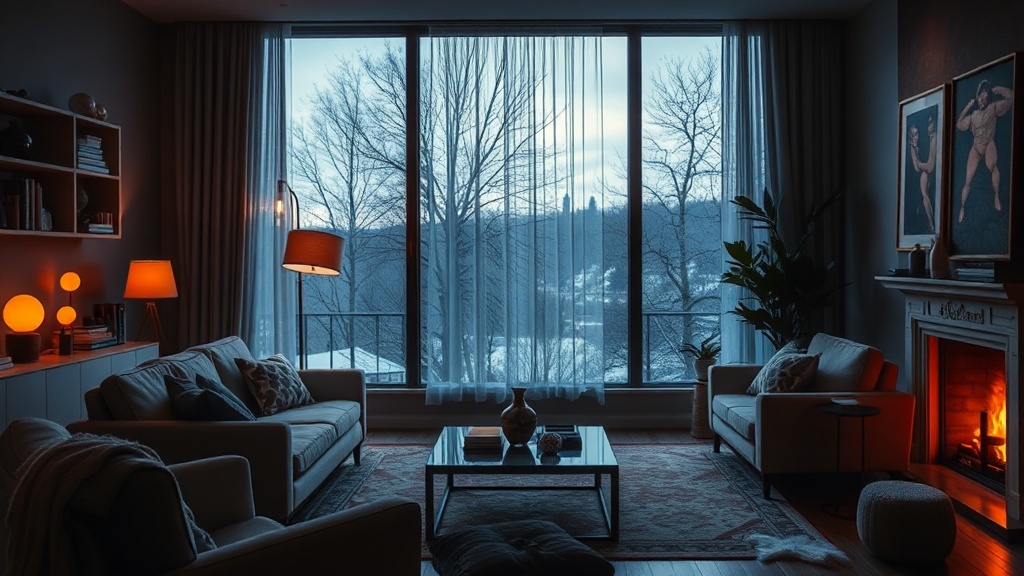
Why Your Living Room Feels Cold and Uninviting

Too Much Matching Furniture
Lack of Soft Textures
Harsh Overhead Lighting
Empty Wall Space
The Absence of Personal Layers
This article identifies the specific design failures that make a living room feel sterile and explains how to rectify them through texture, lighting, and intentional layering. You will learn why your current furniture arrangement might be working against you and how to introduce warmth without succumbing to cluttered, transient trends.
The absence of tactile variety
A room feels cold when every surface offers the same sensory experience. If your seating is a smooth leather sofa, your coffee table is polished marble, and your floors are hard-surface oak, you have created a "sensually flat" environment. While these materials are high-quality, the lack of friction makes the space feel clinical rather than lived-in.
To fix this, you must introduce contrasting textures that invite touch. If you have a sleek, low-profile sofa, pair it with a heavy, chunky knit throw from a brand like Pendleton or a high-pile wool rug. The goal is to create a dialogue between hard and soft. A smooth metal side table becomes much more inviting when it sits next to a linen-upholstered armchair. This tension between the industrial and the organic is what creates depth.
- Natural Fibers: Incorporate linen drapery, jute rugs, or heavy cotton weaves.
- Organic Irregularity: Use stone objects with raw edges rather than perfectly polished spheres.
- Textural Layering: Place a sheepskin or a high-quality Mohair rug over a standard hardwood floor to soften the visual "temperature" of the room.
Over-reliance on overhead lighting
The most common mistake in residential design is the "interrogation" lighting setup—relying solely on a single, bright overhead fixture or recessed spotlights. High-intensity light from above creates harsh shadows and flattens the architectural features of a room, making it feel more like an office or a gallery than a sanctuary. To create a welcoming atmosphere, you must move the light sources down to the eye level of a seated person.
A well-designed living room should utilize a "layered" lighting scheme. This means having at least three distinct sources of light at different heights. A floor lamp provides ambient light, a table lamp offers task lighting for reading, and perhaps a small, cordless LED lamp on a bookshelf provides accent lighting. Look for lamps with warm-toned bulbs (2700K or lower) to mimic the glow of a sunset or a candle.
If your room feels cavernous or uninviting, check your light temperature. If you are using "Daylight" or "Cool White" bulbs, you are effectively killing the warmth of your furniture. Switch to warm-toned bulbs and add a dimmable lamp near your seating area to create "pools" of light. This technique directs the eye and makes the scale of the room feel more intimate.
A lack of scale and proportion
A room feels "off" when the furniture does not respect the volume of the space. This often manifests in two ways: the furniture is too small for the room (making it feel sparse and lonely) or the furniture is too large (making it feel cramped and claustrophobic). Small, spindly furniture in a large room creates a sense of emptiness that feels cold, whereas oversized pieces in a small room feel aggressive.
To achieve balance, consider the "visual weight" of your pieces. A heavy, velvet sofa has significant visual weight and requires a substantial coffee table to anchor it. If you pair a massive sectional with a tiny, glass-topped side table, the room will feel unbalanced. You can learn more about balancing smaller surfaces in our guide on how to style your coffee table to ensure your central pieces act as anchors rather than afterthoughts.
When selecting furniture, look at the height of your ceiling. If you have high ceilings, you need taller elements—such as a large-scale floor lamp or a tall bookshelf—to bridge the gap between the floor and the ceiling. Without these vertical elements, the "dead air" above your furniture will make the seating area feel disconnected from the architecture.
The "Showroom" syndrome
A living room feels uninviting when it lacks evidence of human life. This is not an argument for clutter, but rather an argument against sterility. A room that is perfectly curated but lacks any personal artifacts feels like a temporary staging area rather than a home. This is often the result of buying entire "sets" of furniture from a single retailer, which strips the room of character.
To avoid this, practice the art of the "collected" look. Instead of buying a matching set of end tables and lamps, mix eras and materials. A mid-century modern teak sideboard looks exceptional when paired with a contemporary ceramic vase or a vintage brass tray. This layering of history suggests that the room has evolved over time, which inherently feels more welcoming to guests.
Actionable ways to inject character:
- Curated Books: Use books as sculptural objects. A stack of hardback art books provides height and a sense of intellectual warmth.
- Art with Intent: Avoid generic, mass-produced prints. Opt for framed sketches, textile art, or even a singular, large-scale canvas that demands attention.
- Living Elements: A room without greenery feels static. A large Fiddle Leaf Fig or a simple olive tree in a terracotta pot adds movement and life to a corner.
Poor spatial flow and conversation circles
The layout of your furniture dictates how people interact within the space. If your sofa is pushed directly against a wall or if your chairs are facing a television at an awkward angle, the room will feel functionally broken. A room that does not facilitate conversation will always feel cold because it fails its primary social purpose.
The goal is to create a "conversation circle." This means all primary seating should be oriented toward a central point—usually a coffee table—at a distance that allows for easy eye contact without shouting. If your living room is a long, narrow rectangle, do not try to make one giant seating area. Instead, create two distinct zones: a primary conversation area and a secondary "niche," such as a reading corner with a single armchair and a small side table.
Ensure there is enough "breathing room" between pieces. If people have to squeeze past a coffee table to reach a chair, the room feels high-stress. A minimum of 14 to 18 inches between a sofa and a coffee table is the standard for both comfort and aesthetics. If you find your furniture is constantly being pushed against the perimeter of the room, try "floating" the sofa. Pulling it even twelve inches away from the wall can instantly make the room feel more intentional and high-end.
"Design is not just about what looks good; it is about how a space makes you feel. A room without texture, light, and scale is merely a container. A room with them is a home."
By addressing these four pillars—texture, lighting, scale, and character—you move away from the pursuit of "perfection" and toward the pursuit of atmosphere. A truly inviting living room is not one that looks like a magazine spread, but one that feels deeply, unapologetically lived-in.