No Nails, No Glue, No Forgiveness: What Japanese Joinery Teaches About the Joints We Stopped Caring About

I have a piece of wood on my desk that I cannot pull apart.
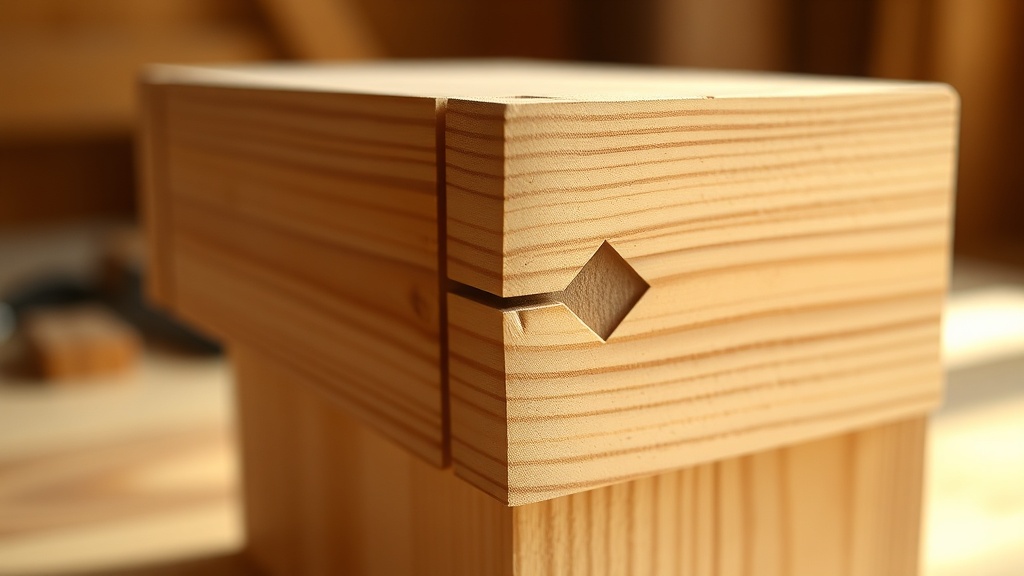
It is two pieces, actually — Japanese cedar, joined with a kawai-tsugi splice. No glue. No screws. No metal of any kind. The joint locks through geometry alone: opposing wedges cut at angles that tighten under load. I bought it from a retired joiner in Hida-Takayama four years ago, and I have been trying to understand it ever since.
Not how it works — that part is mechanical, describable, diagrammable. What I cannot fully articulate is why holding it feels like an accusation against almost everything else in my apartment.
The Logic of Tsugite
Japanese wood joinery — tsugite for splicing joints, shiguchi for angle joints — is not decorative. It is structural grammar. For roughly eight centuries, Japanese carpenters developed a vocabulary of interlocking cuts that hold timber frames together without fasteners. The joints are invisible when assembled. They expand and contract with seasonal humidity. They can be disassembled and reassembled. Some, like the four-way locking joint called shachisen-tsugi-shikuchi-no-shihousashi, are so geometrically intricate that watching them slide together feels like witnessing a proof.
This is design as physics. Not aesthetics applied to structure, but structure that generates its own beauty through the absolute removal of anything unnecessary.
What Flat-Pack Actually Costs
I do not have a grudge against IKEA. Affordable, space-efficient furniture has genuine social value — the same democratic logic that drove the Frankfurt Kitchen. But there is a difference between designing for constraint and designing for disposal.
A cam-lock-and-dowel connection — the standard joint in flat-pack furniture — is engineered to be assembled once, maybe twice. By the third move, the particleboard around the fitting has crumbled. The object becomes waste. Not because it broke, but because the connection was never meant to endure repeated use. The joint was designed for the logistics of shipping, not for the life of the object.
Tsugite inverts this priority entirely. The joint is the most considered part of the structure. It is where the carpenter's intelligence concentrates. A kawai-tsugi splice can be disassembled and reassembled indefinitely because the connection is the wood itself — no secondary material degrades, no fitting loosens, no adhesive fails.
Foster + Partners, of all firms, published research on this. Their conclusion was blunt: timber-only joints are not only functional and beautiful, they are sustainable and adaptable. Reversible connections — joints you can undo without destroying — are exactly what circular-economy construction needs. The ancient technique turns out to be the contemporary solution.
Kengo Kuma and the Quiet Return
Kengo Kuma has spent decades reintroducing tsugite principles into public architecture. His Asakusa Tourism Center in Tokyo stacks traditional wooden-house forms into a vertical column, and the material logic runs deeper than the visual reference. Kuma treats timber joinery as a philosophical position: that buildings should be assemblies of relationships, not monoliths poured from a single material.
This matters because most contemporary architecture treats joints as problems to be hidden. Seams get caulked. Connections disappear behind drywall. The building pretends to be seamless, which is another way of saying it pretends to be simple when it is not. Tsugite does the opposite. The joint is honest. It shows you how the building stands. It invites you to understand.
That honesty is what connects Japanese joinery to every design tradition I care about. The same principle lives in exposed Brutalist concrete, in Müller-Brockmann's visible grids, in Rams's unadorned switches. Show the logic. Trust the user. Do not decorate what should be legible.
The Geometry Is the Ornament
There is a practice called kumiko — lattice work made from thin strips of wood fitted together without nails into geometric patterns. It is traditionally used in shoji screens and ranma transoms. The patterns are mathematically precise: hexagonal, rhombic, radial. They look ornamental, but every angle is structural. Remove one strip and the panel weakens.
I keep returning to kumiko because it demolishes the tired argument that ornament and function are opposites. Adolf Loos was wrong, or at least incomplete. Ornament is not crime when the ornament is doing work. A kumiko panel is pattern and structure simultaneously, the way a well-set paragraph is rhythm and meaning simultaneously.
This is what I mean when I talk about design as a series of gestures. Each cut in a kumiko panel is a decision about angle, grain direction, tension, and visual weight. None of those decisions can be separated from each other. The ornament is not applied to the structure. The ornament is the structure.
What We Forgot, and What We Cannot Afford to Keep Forgetting
The standardisation of building practices did real damage to craft knowledge. Architizer documented this plainly: industrialisation pushed joinery techniques to the margins, replacing skilled handwork with faster, cheaper, less durable connections. We gained speed. We lost intelligence in the joint.
Now the sustainability conversation is circling back. Structure Magazine recently argued that Japanese wood joinery has "untapped potential" in American construction — hybrid methods that combine traditional joints with modern engineering could eliminate metal fasteners, reduce embodied energy, and produce buildings that can be disassembled rather than demolished.
I find it quietly damning that we need research papers to rediscover what Hida carpenters understood in the fourteenth century. But I would rather arrive late than not at all.
The piece on my desk remains locked. Two pieces of cedar, holding each other through nothing but the precision of their meeting. No glue, no screws, no cleverness — just wood, cut with the kind of attention that most of us have stopped believing is worth the time.
It is worth the time.