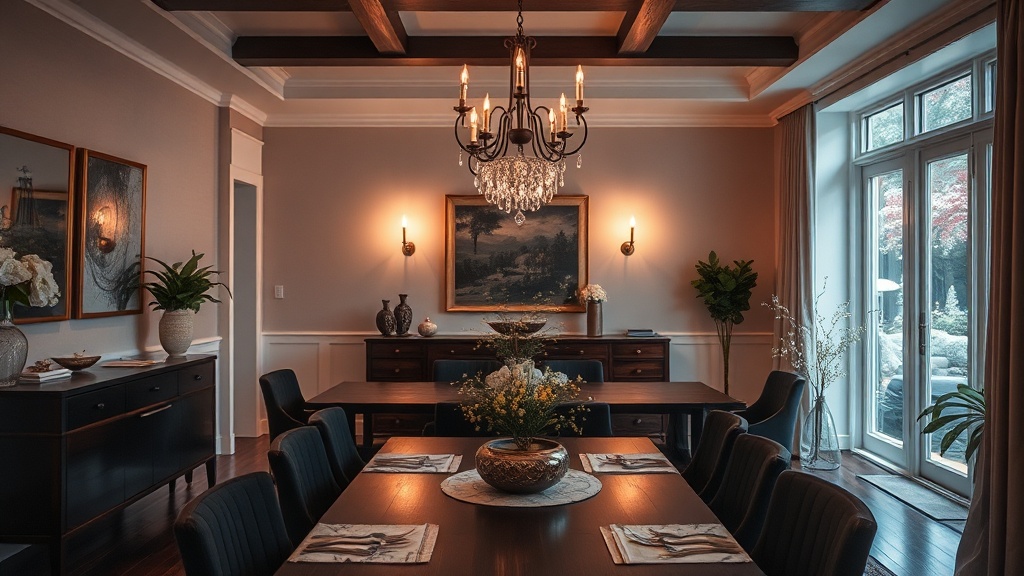
Why Your Dining Room Feels Static and How to Inject Movement

Imagine walking into a dining room that looks exactly like a high-end showroom catalog. The linens are pressed, the centerpiece is perfectly symmetrical, and every chair is positioned at a precise ninety-degree angle. It looks expensive, but it lacks a pulse. It feels frozen. This happens when we focus too much on the furniture as individual objects rather than treating the room as a living, breathing composition. A dining room shouldn't just be a place to consume calories; it should be a stage for human connection, and that requires a certain level of visual kinetic energy.
The problem usually stems from a fear of asymmetry. We've been taught that balance means mirror images, but true sophistication often lies in the tension between different forms. If your table is a heavy, rectangular oak piece, placing a single, identical vase in the dead center creates a sense of stagnation. You need a way to break that line, to disrupt the expectation of perfection.
Can Lighting Change the Mood of a Dining Space?
Lighting is the most undervalued tool in a designer's kit. Most people settle for a single overhead fixture that acts as a blunt instrument of light. It’s functional, sure, but it’s also boring. To create movement, you need to layer your light sources. Instead of relying solely on a central pendant, consider the way light interacts with the periphery of the room.
A low-slung lamp on a sideboard or a small, cordless light placed near a grouping of books adds a secondary glow that pulls the eye away from the center. This creates depth. When the light levels vary, the room feels larger and more complex. If you’re looking for inspiration on how light affects perception, the Architectural Digest often showcases how lighting layers can redefine a room's architecture without moving a single wall.
- The Low Glow: Use table lamps to create intimate pools of light.
- The Statement Piece: A sculptural pendant provides a focal point, but it shouldn't be the only one.
- The Perimeter Light: Subtle light hitting a corner or a plant makes the edges of the room feel alive.
Does Table Linen Texture Matter?
We often treat linens as an afterthought—something to be pulled out only for holidays. But the tactile quality of your table setting dictates how much a guest engages with the space. A flat, polyester tablecloth is visually silent. A heavy linen runner with frayed edges or a set of hand-thrown ceramic plates adds a rhythmic texture that catches the light and breaks up the visual plane.
Think about the contrast between the smooth surface of a polished wood table and the rough, organic texture of a stone coaster. That friction is what makes a room feel curated rather than manufactured. If your table feels "stiff," it’s likely because every surface is too smooth. Introduce something tactile—wood, linen, matte ceramics, or even a hammered metal tray—to give the eye something to grip onto.
The Role of Scale in Centerpieces
Most people under-scale their centerpieces. They place a small bowl of fruit on a massive dining table, and the result is a visual hole in the middle of the room. A centerpiece should have enough volume to hold its own against the furniture, but it shouldn't block the line of sight between people sitting across from one another. I prefer a collection of objects of varying heights—a tall, thin branch in a slender vase paired with a low, heavy bowl. This creates a silhouette that feels intentional rather than accidental.
How Do You Mix Old and New Styles?
The secret to a room that feels lived-in rather than staged is the intentional clash of eras. If you buy a dining set from a single showroom, you’re buying a set piece, not a room. To avoid this, look for pieces that possess a distinct sense of time. A modern, minimalist glass table looks spectacular when paired with vintage, slightly worn wooden chairs. The friction between the sleekness of the glass and the patina of the wood creates a narrative.
This isn't about a "shabby chic" aesthetic, which can often feel dated and cluttered. It’s about a curated tension. A brutalist metal lamp sitting next to a delicate, hand-painted porcelain pitcher tells a story of different histories coexisting. This is where the soul of a room resides. You can find endless examples of how to blend these eras by looking at archives on The Museum of Modern Art, where the interplay of form and history is documented through the lens of functional objects.
When you approach your dining room, stop thinking about it as a set of rules to follow. Instead, think about it as a composition of weight, light, and texture. If a corner feels empty, don't just fill it with a plant; find a light source that casts a shadow. If the table feels too formal, break the symmetry with a stack of books or an asymmetrical arrangement of glassware. The goal isn't to achieve a perfect image, but to create a space that feels like it has a pulse.
Design is most successful when it leaves room for the unexpected. A room that is too "correct" is a room that is dead. Embrace the slight tilt of a vase, the unevenness of a handmade bowl, and the shadow cast by a low-hanging lamp. That is how you turn a dining room from a static display into a place of genuine character.