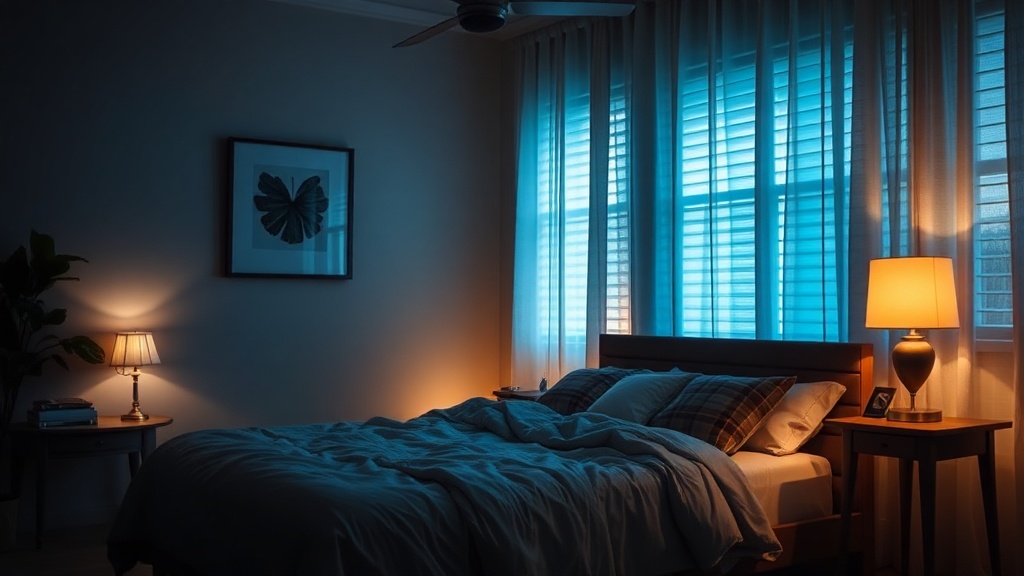
Why Your Bedroom Lighting Makes You Feel Tired

Do you ever lie in bed, staring at the ceiling, feeling strangely wired despite the exhaustion of the day? The culprit is often not your mattress or your sleep hygiene, but the very light hitting your eyes. Most people treat bedroom lighting as an afterthought—a single, harsh overhead fixture or a lonely bedside lamp—but the wrong illumination disrupts your circadian rhythm and keeps your cortisol levels unnecessarily high. This guide examines how to replace clinical, draining light with a layered system that facilitates deep rest through color temperature, lumens, and placement.
The Biological Impact of Light Temperature
The human body operates on a biological clock governed by light. When you are exposed to "cool" light—those blue-toned bulbs often found in modern LED strips or high-end office settings—your brain perceives it as daylight. This suppresses the production of melatonin, the hormone responsible for sleep. If your bedroom feels like a brightly lit pharmacy at 9:00 PM, you are effectively telling your brain to stay awake.
To fix this, you must prioritize Kelvin (K) ratings. The Kelvin scale measures the color temperature of light. For a bedroom, you should strictly avoid anything above 3000K. Instead, look for the following:
- 2200K to 2700K: This is the "Warm White" range. It mimics the glow of a sunset or a traditional incandescent bulb. It is the gold standard for relaxation.
- Amber Tones: If you use smart bulbs, such as the Philips Hue White and Color Ambiance series, program a "Sunset" scene that gradually shifts the light toward the amber end of the spectrum as your bedtime approaches.
A common mistake is buying "Daylight" bulbs (5000K+) for the sake of clarity. While these are excellent for a kitchen or a workshop, in a bedroom, they act as a stimulant. If you find yourself unable to wind down, check the fine print on your bulb packaging; you likely have a light source that is far too blue.
The Failure of the Single Overhead Source
The most significant design error in bedroom layouts is the reliance on a single, central ceiling fixture. This creates "flat" lighting, which casts harsh, unflattering shadows and eliminates the sense of depth in a room. When light comes from directly above, it creates a clinical atmosphere that lacks the intimacy required for a sanctuary.
To create a professional-grade lighting scheme, you must implement layering. A well-designed bedroom requires three distinct layers of light:
1. Ambient Lighting (The Foundation)
This is your general illumination. Instead of a standard flush-mount ceiling light, consider a dimmable pendant or a sculptural chandelier. A piece like the George Nelson Bubble Lamp provides a diffused, soft glow that fills the room without creating sharp edges of light. The goal here is not brightness, but a soft, ambient wash that can be lowered as the evening progresses.
2. Task Lighting (The Utility)
Task lighting serves a specific purpose: reading or dressing. Bedside lamps are the standard choice here, but the height and shade material matter immensely. If you are reading in bed, you need a directional light that doesn't bleed into your eyes. A small, adjustable brass task lamp—something with a heavy base and a focused neck—is far more effective than a large, glowing globe that illuminates the entire room.
3. Accent Lighting (The Mood)
Accent lighting is where you add character and texture. This might be a low-wattage LED strip tucked behind a headboard to create a halo effect, or a small spotlight directed toward a piece of art or a textured wall. This layer adds depth and makes the room feel curated rather than merely "furnished."
The Importance of Diffusion and Materiality
Even with the correct Kelvin rating, light can feel "tired" if it is too direct. Direct light—where the bulb is visible or the light hits a surface with high intensity—creates visual noise. To achieve a restful environment, you must prioritize diffusion.
Look for light fixtures made from materials that naturally soften light. Natural linen, frosted glass, and even high-quality paper (like the Isamu Noguchi style lanterns) are excellent at scattering photons. A linen shade on a bedside lamp doesn't just look better; it creates a soft-focus effect that reduces the visual stimulation hitting your retina. Avoid clear glass shades or exposed Edison bulbs near your head while you are trying to sleep, as the high-contrast glare can be jarring to the nervous system.
If you are working with a budget, the simplest way to improve diffusion is to ensure no light source is "naked." If you have a ceiling light that feels too bright, a fabric shade can transform a harsh glare into a gentle glow.
Controlling the Light: Dimmers and Smart Systems
The ability to control the intensity of light is just as important as the light itself. A room with a single "on/off" switch is a room that lacks nuance. If you cannot hardwire a dimmer switch into your walls, there are several non-invasive ways to gain control:
- Plug-in Dimmers: For bedside lamps, a simple plug-in dimmer slider can give you granular control over the light level without a full electrical overhaul.
- Smart Plugs: Using a device like the TP-Link Kasa Smart Plug allows you to set schedules. You can program your lamps to slowly dim over 30 minutes, mimicking a natural transition to darkness.
- The "Low-Level" Rule: As a rule of thumb, the closer a light source is to your eyes, the dimmer it should be. Your bedside lamp should be significantly lower in intensity than your ceiling light.
By automating these transitions, you remove the cognitive load of "preparing for bed." The room prepares itself for you, signaling to your biology that the day is over.
Common Pitfalls to Avoid
As you redesign your lighting, avoid these three frequent mistakes that even seasoned decorators often make:
- The "Blue Light" Trap: Many people use their smartphones or tablets as their primary light source in bed. The high-intensity blue light from a screen is even more disruptive than a bad bulb. If you must use a device, use a "Night Shift" mode, but ideally, move toward analog activities like reading a physical book under a warm lamp.
- Over-Lighting the Corners: Dark corners can make a room feel small and uninviting, but too much light in the corners can make a room feel "busy." Use small, low-wattage uplights in corners to create a sense of height and warmth without overwhelming the space.
- Ignoring the Light's Path: Always consider where the light is being cast. A lamp that shines directly into your eyes while you are lying down is a failure of design, regardless of how beautiful the lamp is. Always test your light placement while lying in your actual bed position.
A bedroom should be a curated environment designed for one specific function: recovery. By treating your lighting with the same precision you would use for a structural element of the room, you move away from the "tired" aesthetic and toward a space that truly supports your well-being.