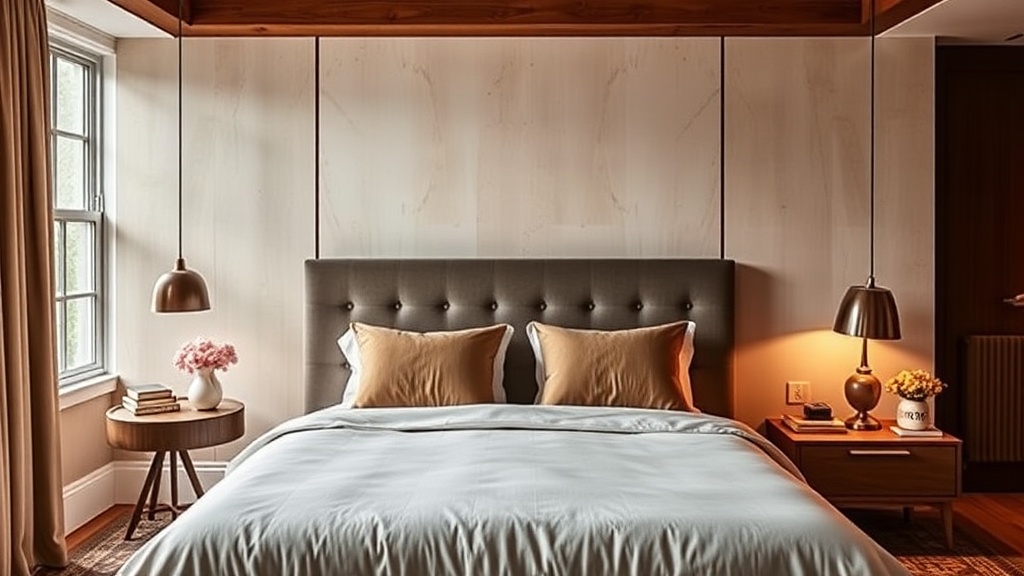
Which Wall for the Bed? Solving Your Bedroom's Biggest Layout Question

The Empty Room Dilemma
You stand in the doorway with a coffee in one hand and a tape measure in the other, staring at four walls that suddenly feel less accommodating than they looked in the listing photos. The mattress is still wrapped in plastic downstairs, the movers are on the clock, and you're realizing that the wall you mentally designated for the bed—that perfect center spot you envisioned—has a radiator, a light switch in exactly the wrong place, and a window that will leave the headboard either blocking the view or floating awkwardly off-center. This is the moment where most bedroom layouts go wrong: before a single piece of furniture crosses the threshold.
Bed placement isn't just about where the frame fits. It's about circulation paths that don't require a morning obstacle course, nightstand accessibility when you're half-asleep, and sight lines that don't make the room feel like an afterthought. Get this decision right, and even a modest bedroom feels intentional and calm. Get it wrong, and you'll spend years bumping into corners and wondering why the space never quite clicks. This guide walks through the practical considerations—clearance requirements, architectural constraints, and the subtle psychology of where we place our most important piece of furniture.
How Much Clearance Do You Actually Need?
Before you commit to a wall, you need to understand the invisible buffer zones that make a bedroom functional. The general rule of thumb is 24 inches of clear walking space on at least one side of the bed—preferably both. This isn't arbitrary; it's the minimum for comfortable passage without turning sideways, and it's what allows you to make the bed without performing gymnastics. If you're working with a queen-sized frame (60 inches wide) in a room that's 120 inches across, that leaves you with roughly 30 inches on each side—tight, but workable.
But clearance isn't just about the sides. Consider the foot of the bed. You need at least 36 inches between the mattress edge and any opposing wall or furniture piece. Less than that, and you're shortening your visual field every time you enter the room, creating a corridor effect that feels claustrophobic. This is why platform beds with built-in storage often work better in small rooms than traditional frames with separate dressers—they preserve that precious foot-of-bed breathing room while still giving you drawer space.
Don't forget vertical clearance, either. If you're positioning the bed under a sloped ceiling or eaves, ensure you have at least 30 inches above the mattress where your head will be. Anything less creates a subconscious sense of compression that can affect sleep quality. Measure twice, and always account for baseboards, crown molding, and the reality that your mattress might be thicker than the standard 10-12 inches you assumed.
What If Every Wall Has a Window or Door?
The classic bedroom layout assumes a blank wall—preferably the longest one, opposite the entry door, with no windows. If you're laughing right now because your actual bedroom has windows on three walls, a door that swings into the middle of the space, and possibly a closet with bifold doors that eat into usable floor area, you're not alone. Older homes, converted spaces, and urban apartments often present this exact challenge.
When windows dominate your options, you have three approaches. First, embrace the asymmetry. Place the bed so that the headboard partially covers a window, but offset it so the window frames the bed rather than crowning it. This works best with lower-profile headboards (under 48 inches) and windows that don't extend to the floor. Install curtains or Roman shades that can be drawn completely clear of the window frame to maximize light when open and provide privacy when closed.
Second, consider floating the bed. This means positioning it in the center of the room or angled in a corner, with the headboard facing the entry door. This creates a "command position" that psychologists and feng shui practitioners alike recommend—you can see the door without being directly in line with it. Floating requires more square footage (you need clearance on all sides), but in a spacious master bedroom, it can create a resort-like sense of intentionality. Use the space behind the bed for a narrow console table or desk that doubles as a headboard.
Third, work with the architecture rather than against it. If you have a fireplace, built-in shelving, or a particularly striking window arrangement, consider making that the room's focal point and placing the bed perpendicular to it. This creates a seating or viewing area at the foot of the bed—a luxury in larger spaces. House Beautiful showcases numerous examples of bedrooms where the bed faces a fireplace or window wall rather than backing up to it, creating a completely different spatial experience.
Does the Bed Always Need to Be the Focal Point?
Conventional wisdom says yes—the bed should anchor the room, typically centered on the main wall. But conventional wisdom also gave us popcorn ceilings and wall-to-wall carpeting. In reality, the bed is often the largest piece of furniture in the room, which makes it a de facto focal point regardless of where you put it. The question is whether you want to emphasize that or distribute visual interest elsewhere.
In smaller bedrooms (under 120 square feet), treating the bed as the clear focal point usually makes the most sense. Use a headboard with texture or color, layer bedding with intention, and keep side tables minimal so they don't compete. The eye needs a landing spot, and in tight quarters, splitting attention between multiple "moments" creates visual chaos.
But in larger bedrooms—master suites or loft spaces—you have permission to decentralize. Place the bed in a corner to create a cozy sleeping nook, then use the remaining space for a reading chair, a small desk, or a dressing area. This "zoning" approach makes a large room feel more intimate and functional. The key is defining each zone with rugs, lighting, or furniture grouping so the room doesn't feel like a furniture warehouse with random pieces scattered about.
Another option: make the windows the focal point. This works particularly well with floor-to-ceiling glass or a particularly striking view. Place the bed perpendicular to the window wall, add a bench or chaise beneath the glass, and keep window treatments minimal. You're trading the traditional "bed as centerpiece" layout for something that prioritizes the connection to outdoors—an increasingly popular approach in contemporary bedroom design.
The Case for Intentional Asymmetry
Matching nightstands flanking a centered bed—it's the default setting, the furniture set you see in every catalog. But symmetry can feel static, even sterile. Asymmetry introduces energy and allows you to solve real problems (like that radiator we mentioned earlier) without sacrificing functionality.
If one side of the bed has a window close to the edge, skip the matching nightstand on that side. Use a narrow wall-mounted shelf or a slender pedestal table that doesn't block the light. On the other side, use a larger piece—a small dresser or desk that provides storage and surface area. This "his and hers" approach (though we prefer "theirs and theirs") acknowledges that different sleepers have different needs. Maybe one person reads and needs a substantial lamp and stack of books; maybe the other just needs a charging station and a place for water.
Asymmetry also helps with door swings. If a door opens against one side of the bed, don't force a nightstand into the remaining few inches of clearance. Leave that side open, place a small stool or chair elsewhere in the room that can be pulled over when needed, and concentrate your storage on the unobstructed side. The room will feel more spacious, and you won't be ducking around a door every morning.
When to Break the Rules
For every guideline in this article, there's a stunning interior that ignores it completely. The 24-inch clearance rule? Broken in countless European bedrooms where space is at a premium. The command position? Disregarded in Japanese futon traditions where the bed rolls away each morning. The centered bed? Abandoned in loft spaces where the architecture demands creativity.
The real rule is consistency. If you're going to place the bed in an unconventional spot—angled in a corner, blocking a window partially, or floating in a vast space—commit to that decision. Don't apologize for it with half-measures. Use lighting to reinforce the choice: pendant lights or wall sconces can anchor a floating bed in a way that makes it feel inevitable rather than temporary. If you're angling the bed, angle the rug underneath it too, creating a distinct zone that explains the geometry.
Also consider your actual sleep habits. If you always enter the bed from one side because your partner is a heavy sleeper who gets up later, prioritize clearance and accessibility on your side. If you read in bed for an hour each night, ensure your side has proper task lighting and surface area for books and glasses. The best layout serves the people using it, not the other way around. A room that looks perfect in a photograph but requires you to crab-walk to the closet every morning is a failed design, regardless of how well it follows convention.
Measure your space. Test your pathways. And remember that the bed doesn't have to stay where you first put it—the beauty of furniture on legs is that it can move when your needs change.