UK Road Signs Design: The Traffic System Built for Speed

UK Road Signs Design: The Traffic System Built for Speed
Excerpt (156 chars): UK road signs design is a lesson in visual restraint. Kinneir and Calvert built a system for speed, not applause.
Tags: uk-road-signs, transport-typeface, information-design, wayfinding, typographic-systems

Note the way a road sign speaks while you are already moving. It has seconds—sometimes less—to change your decision. UK road signs design succeeds because it was built for those seconds, not for the portfolio.
Context: In late‑1950s Britain, car ownership surged and motorways arrived faster than any unified visual language. The old signage was inconsistent and frequently illegible at speed. The Kinneir‑Calvert system solved that with a disciplined, human‑tested program of type, color, spacing, and pictograms. It is one of the rare cases where graphic design directly reduced cognitive load in a life‑critical environment.
The Brief Was Speed, Not Style

Note the way the system begins with a question rather than a style. Kinneir reportedly asked: What do I want to know, trying to read a sign at speed? That single framing forces every later decision—letterforms, color hierarchy, arrow shapes, spacing rules—into a coherent order. There is no room for ego when the driver is already past the exit.
The first milestone was motorway signage. The work began in the late 1950s, with prototype testing in real environments—signs propped against trees in Hyde Park and positioned in car parks to measure legibility and distance. This is the opposite of the contemporary mock‑up culture. It was design in the field, under motion, in imperfect light.
The second milestone was the Worboys Committee in 1963, which re‑formed signage for all‑purpose roads and made the system national. By January 1, 1965, the new road sign system became law. The discipline here is not just aesthetic; it is legislative. The system is enforceable because it works.
There is a deeper lesson hiding here: when the brief is urgent enough, design stops being a taste argument. It becomes a public contract. Every sign is a promise that the information will arrive in time, in a form the human eye can absorb without panic. This is why so much of the system feels almost “over‑designed”—the generous margins, the strict letter‑spacing, the refusal to compress information into clutter. They bought time for the driver. Time is the only luxury you have at 70 miles per hour.
Transport: A Typeface That Refuses to Flutter
Transport is not a pretty typeface. It is a durable one. Its letterforms were engineered for legibility at speed and in mixed lighting. The lower‑case letters are generous. The apertures are open. The rhythm is steady. The typeface is essentially a public‑safety instrument.
The family’s split into Transport Medium and Transport Heavy is a piece of quiet brilliance. Reflective white lettering on blue motorway panels reads differently at night than black lettering on white or green. The heavier weight compensates for light spill and haloing. The design recognizes a physical fact and corrects for it. That is material honesty.
There is also a system of spacing based on stroke width—an early, pragmatic form of modular scaling. Kinneir and Calvert used the width of the capital “I” as a unit, so borders, margins, and inter‑line gaps would scale proportionally as the sign grew or shrank. It is typographic logic disguised as civil engineering.
Look closely and you’ll also see an insistence on mixed‑case typography at a time when many road signs still defaulted to all caps. Mixed case is not a stylistic preference; it is a recognition of how we read. The shapes of words become identifiable by their ascenders and descenders, which is precisely what you need when your eye is scanning rather than reading. This is the moment where typography ceases to be graphic decoration and becomes cognitive ergonomics.
If you want the contemporary echo, look at the pictogram systems of Tokyo 1964 or the Helvetica‑based public signage that still governs modern transport hubs. I have written on both; the DNA is the same. Clarity as infrastructure, not branding. See: Tokyo 1964 Olympic Pictograms: The Grammar of Clarity and The Invisible Standard: Why Helvetica Still Owns the Room.
Color, Shape, and the Ethics of Hierarchy

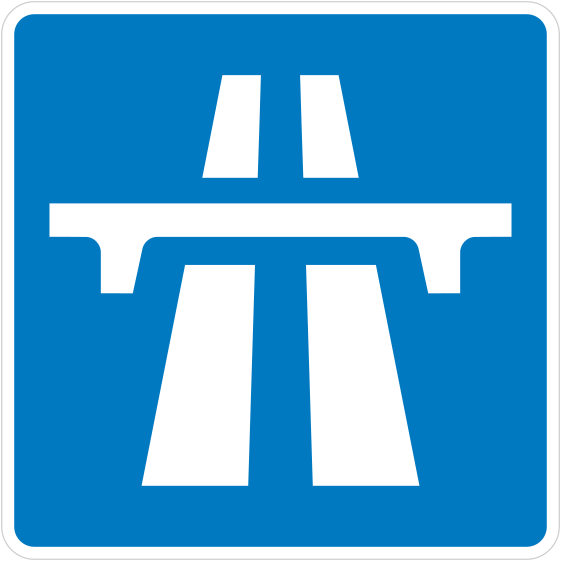
Note the way color is used not to decorate but to declare. Blue for motorways, green for primary routes, white for secondary. Triangles warn. Circles command. Rectangles inform. This wasn’t invented for Britain; it aligned with European protocols to reduce the learning curve for drivers crossing borders. The design language is a shared grammar, not a local dialect.
The hierarchy works because it is consistent. A driver can identify a warning sign before they can read it. The color and shape do the first half of the job; the typeface finishes the sentence. This is what modern brand systems often miss: hierarchy is a safety mechanism, not a stylistic flourish.
Even the arrow geometry follows the same ethic. The arrows are not expressive; they are mechanical. They sit at predictable angles, with predictable weights, and they are placed where your peripheral vision already expects them. These are small decisions, but in combination they form a visual rhythm that turns a chaotic roadside into a readable sequence. In other words: it is wayfinding as choreography.
When people call the system “boring,” I hear a compliment. Boring means predictable. Predictable means fast. Fast means safe. That is the real chain of value. Today, the Traffic Signs Manual and the TSRGD (Traffic Signs Regulations and General Directions) keep that grammar consistent across Britain. The system is still taught, enforced, and revised as a public standard—not a fashion.
The Human Gesture Inside the Pictograms

Margaret Calvert’s pictograms are a reminder that a system can be strict and still compassionate. The “children crossing” sign is a small masterclass in empathy—replacing an archaic schoolboy figure with a girl leading a boy. The “farm animals” sign borrows a cow from her own memory. These are not cute anecdotes. They are proof that an abstract system still needs human observation.
This is where the UK road signs design system differs from so much corporate wayfinding today. Corporate Memphis tries to perform friendliness. Calvert simply built it into the gesture. The result is quieter and longer‑lived.
What It Still Teaches Us
The system endures because it was built for the worst case. Poor light. Bad weather. Split‑second decisions. It assumed the user was distracted and designed for that reality instead of punishing it. That is what “human‑centered” should mean.
Modern UI design could learn from this. Don’t add personality where clarity is required. Don’t confuse expression with communication. And don’t mistake novelty for progress. If your interface can’t be read at speed, in stress, or in imperfect conditions, it is ornamental.
The takeaway: Design that survives decades is not louder—it is more legible.
Sources
- Design Museum: Kinneir & Calvert profile and system history
- The National Archives: Worboys Committee report record
- UK Department for Transport: TSRGD overview
- The Guardian: Recent profile on Margaret Calvert