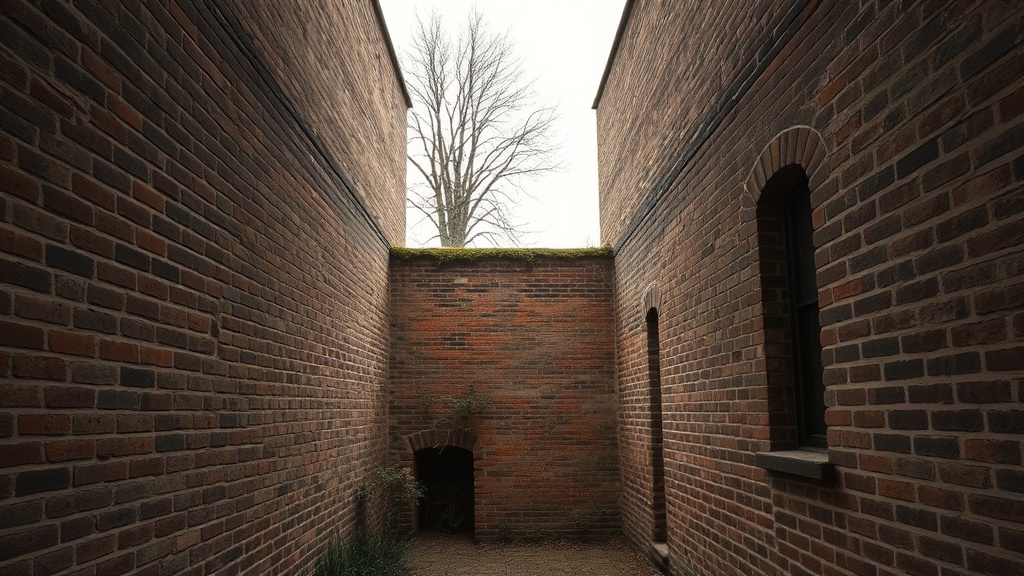
The Walled Garden Is Architecture's Most Honest Room—And You Forgot It Has No Ceiling

There is a room in every serious building that the architect forgot to include: the one without a roof. I do not mean a courtyard, which is a concession to light and ventilation, a technical solution disguised as generosity. I mean a walled garden—a hortus conclusus—where the enclosure is the entire point and the absence of ceiling is the confession that architecture cannot finish the sentence it started.
The walled garden is the only typology I know that begins with an act of humility. Four walls go up. Then nothing. The sky does what the sky does. Rain enters. Light shifts. Seasons rewrite the interior without asking permission. No other room in the history of building tolerates this kind of insubordination from its environment, and that tolerance is precisely what makes the walled garden more architecturally rigorous than most things with HVAC systems and planning approval.
The Monks Understood Enclosure Before Architects Did
The medieval hortus conclusus was not a garden in the way your neighbours have a garden—a patch of grass held hostage by a fence. It was a theological argument rendered in stone and soil. The walls kept the fallen world out. The plants inside were curated not for aesthetics but for meaning: roses for the Virgin, lilies for purity, a fountain for baptismal waters. Every stem was a footnote in a spatial essay about paradise.
What interests me is not the symbolism—you can read that in any garden history survey and feel appropriately cultured at dinner—but the spatial logic. The monks built a room whose programme was attention. The walls existed to eliminate the horizon, to compress your visual field until the only things left were the plants, the stone, and the column of sky above you. This is the same logic that makes a gallery work, that makes a book work, that makes any designed frame work: limitation as generosity.
We have entirely abandoned this principle outdoors. The contemporary garden has no edges. It "flows" into the landscape, it "blurs boundaries," it performs openness as if enclosure were a character flaw. Open-plan ideology colonised the garden the same way it colonised the kitchen, and with the same result: everything is visible, nothing is felt.
Zumthor's Dream Was Just a Good Wall
When Peter Zumthor designed his 2011 Serpentine Gallery Pavilion, he gave London a black box that opened inward to a garden by Piet Oudolf. He called it a hortus conclusus. The press called it "contemplative," which is what journalists say when they cannot find the spectacle they were expecting.
But Zumthor said something sharper than any review: "Every time I imagine a garden in an architectural setting, it turns into a magical place. I think of it as a secret garden—not the one from the story, but the one in the mind." That sentence contains more design intelligence than most manifestos. He was not describing a garden. He was describing what happens to spatial perception when you remove the roof and keep the walls—when you build a room that confesses its incompleteness.
The Serpentine pavilion worked because it refused to be looked at from outside. The exterior was mute. Black timber, no windows, no invitation. You had to enter, and once inside, the enclosure reorganised your senses. The garden was not decoration. It was the room. Oudolf's planting—loose, structural, deliberately unmanicured—became the furniture, the wallpaper, and the view simultaneously.
This is what the walled garden does that no other outdoor space can: it turns a garden into an interior without sacrificing its relationship to weather. It is a room that breathes. And breathing, in architecture, is almost always an afterthought.
Barragán Already Knew—He Just Used Pink Walls
Luis Barragán's courtyards in Mexico City operate on the same principle, though his walls are louder. That volcanic pink, that ochre, those planes of colour that have launched a thousand Instagram accounts—they are not surfaces. They are enclosures. Every Barragán garden is a hortus conclusus wearing a better outfit.
What Barragán understood, and what contemporary landscape architecture has largely forgotten, is that a wall is not a barrier. A wall is a spatial instrument. It creates a pressure differential between inside and outside. Stand on one side: the city, traffic, noise, the relentless visual diet of urban life. Step through: silence, a single tree, water moving slowly across stone, the sky reduced to a rectangle. The garden does not exist despite the wall. The garden exists because of the wall.
His Casa Gilardi courtyard is the proof. A corridor leads to a pool. The pool is enclosed. Light enters through a slot and turns the water into a sheet of colour. There are no plants. It is still, inarguably, a garden—because the enclosure creates the conditions for attention that define a garden in the first place. A garden is not a collection of plants. A garden is a frame that tells you where to look.
Why the Contemporary Garden Fails
Most gardens built today are designed to be photographed from above by a drone or at eye-level by a phone. They are composed for the rectangle of a screen, not for the cylinder of a body standing inside them. This is the same problem as designing a typeface for how it looks in a specimen sheet rather than how it reads at 9pt in a paragraph—the wrong frame produces the wrong result.
The walled garden cannot be photographed well. Its power is sequential: the approach, the threshold, the compression, the reveal. No single image captures it because no single image captures what it does to your proprioception—your body's awareness of itself in space. You feel a walled garden before you see it. The temperature changes. Sound deadens. The sky, suddenly framed, becomes an object rather than a background.
This is why I find most "outdoor room" design so depressing. A pergola with festoon lights is not a room. A deck with a fire pit is not a room. These are furniture arrangements that happen to be outside. A room requires walls, and walls require the courage to say: this is inside, that is outside, and the threshold between them matters. The walled garden is the only outdoor typology that takes this boundary seriously.
Build the Wall First, Then Decide What Grows
If I were advising anyone designing an outdoor space—and I am rarely asked, because my advice tends to involve building more walls, which is not what people want to hear—I would say: start with the enclosure. Not the planting plan, not the paving material, not the lighting scheme. The wall. Its height, its material, its relationship to the body. Can you see over it? If yes, it is a fence. Can you see through it? If yes, it is a screen. A wall is opaque, taller than your sightline, and unapologetic about being solid.
The material matters more than you think. Brick weathers. Stone ages. Rendered concrete cracks and stains. These are not defects; they are the wall entering into a conversation with time, which is the only conversation worth having in a garden. A garden is a temporal medium—it changes hourly, seasonally, annually—and the wall should participate in that change rather than pretending to be permanent.
The height matters even more. A 1.2-metre wall is a boundary. A 2.4-metre wall is an enclosure. A 3-metre wall is a room. The difference is not incremental; it is categorical. At 3 metres, you lose the horizon, the neighbours, the visual noise of everything beyond the wall. You gain the sky as a ceiling, the wall as a surface for shadow-play, and the garden as a place you are genuinely inside.
The Garden That Admits It Cannot Control the Sky
Every other room in a building is a climate-controlled argument against entropy. Walls, roof, insulation, mechanical systems—all working to maintain a steady state against the chaos outside. The walled garden abandons this fight. It builds three-quarters of a room and then stops, deliberately, as if to say: we have done what we can. The rest is weather.
I find this honest in a way that almost no contemporary design manages to be. We live in an era of total environmental control—smart thermostats, automated blinds, circadian lighting—and the walled garden is the architectural equivalent of opening a window and leaving it open. It is a designed space that accepts imperfection as a material. Frost will kill the lavender. Rain will darken the stone. The wall will green with moss on its north face. None of this is failure. All of it is the garden working exactly as intended.
The monks knew this. Zumthor knew this. Barragán knew this. The question is whether we are still capable of designing spaces that admit they cannot finish themselves—that the best room is the one that leaves a wall open to the sky and trusts what comes through.
I suspect we are not. But the walled garden remains, waiting for anyone willing to build four walls and stop.