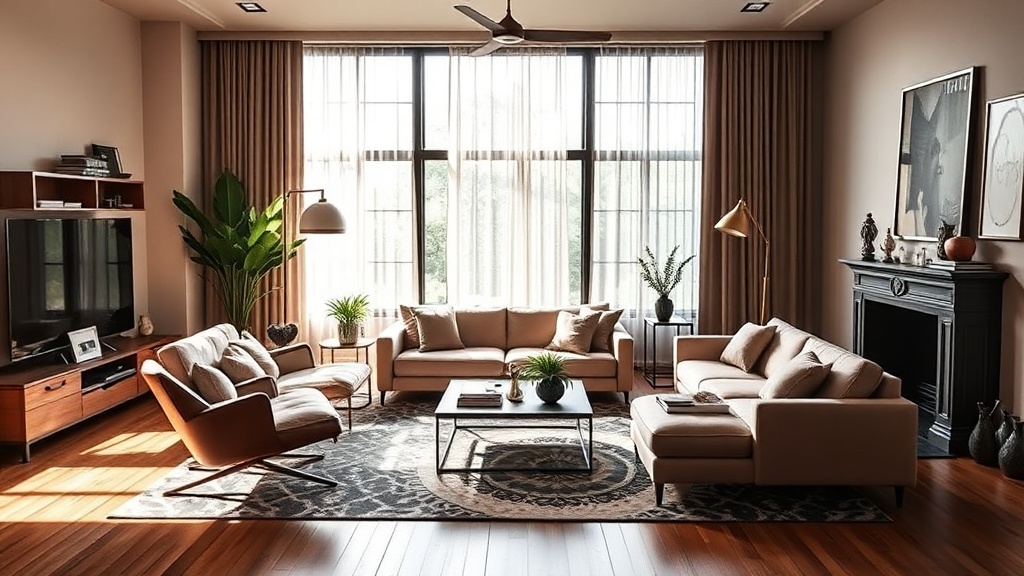
The Complete Guide to Living Room Layouts That Actually Work

The Foundation: Understanding Spatial Relationships
This guide covers five proven living room layouts that prioritize circulation, conversation, and proportion over passing trends. The goal is straightforward: to provide measurable spatial strategies that transform how a room functions, regardless of square footage or budget.
Most living rooms fail not because of poor taste, but because of poor planning. A £3,000 sofa positioned incorrectly becomes an obstacle. A £50 side table placed with intention becomes essential. The following principles are rooted in classical proportion and tested human behavior, not algorithmic recommendation engines.
The 2.4-Metre Rule: Why Distance Matters
Before selecting furniture, understand the 2.4-metre rule—the optimal distance between primary seating for comfortable conversation. Research from the University of Minnesota's Design Research Laboratory found that seated individuals maintain relaxed dialogue when positioned between 2.1 and 2.7 metres apart. The sweet spot of 2.4 metres allows for natural voice levels without leaning forward.
This measurement dictates everything that follows. A 4.5 x 3.6 metre living room (the average UK living room size) accommodates this rule with precision. Anything smaller demands tighter furniture profiles. Anything larger requires intentional zoning to prevent the space from feeling cavernous.
"A room is not a photograph. It is a sequence of movements that unfold over time. The best layouts account for the body in motion, not just the eye at rest."
Layout One: The Symmetrical Conversation
The Configuration
Two sofas facing each other, separated by 2.4 metres, with a shared coffee table centered between them. This layout requires a minimum room width of 3.6 metres to allow 60cm circulation paths on either side.
When It Works
This arrangement excels in rooms with a focal point—whether a fireplace, a window with garden views, or a built-in media unit. The symmetrical nature creates visual calm and signals formality without stiffness.
The Islington Townhouse project by Studio Ashby demonstrates this principle. Two 210cm B&B Italia Charles sofas face each other across a 140cm travertine coffee table. The 2.45-metre gap allows for the Persian Tabriz rug (305 x 244cm) to anchor the arrangement while leaving 45cm of floor visible around its perimeter—a proportional standard rooted in 18th-century salon design.
Critical Measurements
- Sofa depth: 90cm maximum to preserve floor space
- Coffee table height: 45cm (5cm below seat height)
- Side table placement: Within 50cm of each sofa arm
- Rug clearance: Minimum 45cm from walls on all sides
Layout Two: The L-Shape for Open Plans
The Configuration
A primary sofa (210-240cm) anchored against a wall, with a perpendicular two-seater or pair of armchairs forming the L. The corner creates a defined zone without erecting barriers.
The 1.2-Metre Clearance Standard
Open-plan living requires circulation routes that feel natural rather than enforced. The 1.2-metre clearance—the minimum width for two people to pass comfortably—must be maintained between the back of the sofa and any kitchen island, dining table, or traffic path.
In the Hackney Warehouse conversion by Emil Eve Architects, a 220cm sofa from SCP faces the restored Crittall windows. Two 75cm-wide De La Espada armchairs angle inward from the east wall, creating an L that defines the living zone while maintaining 1.4 metres of clearance to the dining area. The result reads as distinct rooms without a single partition.
Common Errors
- Floating the sofa too far from walls. In spaces under 5 metres wide, this fragments the room unnecessarily.
- Ignoring the back view. If the sofa back faces an entrance, specify a low-profile piece (under 85cm height) or place a console behind it with a lamp and books.
- Mismatched seat heights. Keep all seating within 5cm of the same height to avoid visual discord.
Layout Three: The U-Shape for Entertaining
The Configuration
Three seating pieces forming a U: typically a sofa opposite two armchairs, with a coffee table centered within the enclosure. This arrangement seats six to eight and prioritizes face-to-face interaction.
Spatial Requirements
The U-shape demands depth. A room measuring at least 4.8 x 4.2 metres is necessary to prevent the configuration from feeling compressed. The open end of the U should face the room's primary entry point or the most significant architectural feature.
The Bloomsbury Apartment by Ilse Crawford's Studioilse employs this layout with surgical precision. A 240cm vintage Danish sofa faces a pair of 1940s French armchairs (each 78cm wide). The 160cm Moroccan pouf occupies the open side, serving as flexible seating that maintains sightlines. The total footprint: 3.8 x 3.2 metres, leaving generous circulation to the bookshelves beyond.
The Numbers
- Distance between facing seats: 2.4 metres
- Coffee table width: Maximum 90cm to allow passage around it
- Armchair spacing: 15cm gap between chair and adjacent wall
- Pouf/ottoman dimensions: 60cm square minimum for viable seating
Layout Four: The Floating Plan for Large Spaces
The Configuration
All furniture positioned away from walls, creating circulation paths on all sides. This layout treats the room as a gallery or salon, with the furniture arrangement as the central exhibit.
When to Deploy
Spaces exceeding 6 x 5 metres benefit from floating plans. The technique creates intimacy in cavernous rooms and allows for multiple activity zones—reading, conversation, music—within a single volume.
The Fitzrovia Loft by Michaelis Boyd demonstrates the approach. A 280cm Minotti Andersen sofa floats 2 metres from the rear wall, facing a pair of 85cm-wide Knoll Barcelona chairs. A 200cm-wide Pernilla armchair by Bruno Mathsson angles toward the group from the south. The total arrangement occupies a 4.5 x 4.5 metre zone within a 7 x 6 metre room, leaving the perimeter for bookshelves, a piano, and circulation.
The Anchoring Elements
Floating plans require deliberate grounding mechanisms:
- A rug large enough for all front legs of furniture to rest upon (minimum 300 x 250cm for a three-piece arrangement)
- A substantial coffee table (minimum 120 x 80cm) to visually weight the center
- Lighting that drops into the arrangement—arched floor lamps or pendant lights positioned directly above the coffee table
Layout Five: The Narrow Room Solution
The Configuration
For rooms under 3 metres wide, the standard rules invert. Furniture aligns along a single axis, with seating positioned against walls and the center kept clear.
The Gallery Approach
A 2.4-metre-wide Victorian terrace living room cannot accommodate perpendicular arrangements. The solution: a 200cm sofa against one long wall, a 45cm-deep console opposite for display and storage, and two compact armchairs (65cm wide maximum) that flank the fireplace or window at the narrow end.
The Kentish Town Victorian by House of Grey employs this strategy. The 210cm sofa occupies the south wall. Two 62cm-wide &Tradition Shuffle chairs position at 45-degree angles to the garden window, creating a diagonal sightline that visually widens the room. The total furniture depth from walls: 90cm, leaving a 1.2-metre clear corridor through the center.
Specific Product Recommendations
- Sofa depth: 85cm maximum (look for "apartment size" specifications)
- Armchair width: 70cm maximum
- Coffee table: Omit entirely or use a 50cm-diameter side table between chairs
- TV placement: Wall-mounted with full-motion arm to eliminate stand depth
The Details That Elevate Any Layout
Lighting as Spatial Definition
Every layout requires three light sources minimum, positioned to eliminate facial shadows during conversation. The 1.7-metre standard—light sources positioned 1.7 metres above seated eye level—creates flattering, functional illumination.
Anglepoise's Original 1227 Giant floor lamp (height adjustable to 2.2 metres) and the FLOS Arco (2.4-metre reach) are proven solutions for living rooms without ceiling fixtures. Position these to drop light into the center of seating arrangements, not to graze walls.
The 38-Centimetre Rule for Surfaces
Side tables adjacent to seating should measure within 5cm of the seat height—typically 55 to 60cm. The surface should extend no more than 38cm from the arm to remain within comfortable reaching distance while seated. The Hay Revolver (38cm diameter) and the Ercol Originals drop-leaf table (45cm width) satisfy this requirement.
Visual Weight Distribution
Balance heavy elements—upholstered pieces, substantial case goods—across the room's vertical axis. A 90cm-deep sectional on the left demands equivalent visual mass on the right: perhaps a floor-to-ceiling bookshelf, a substantial console with lamp and mirror, or a pair of armchairs with a side table between.
Executing the Layout
- Measure twice. Record room dimensions, door swings, window heights, and radiator positions before selecting furniture.
- Map with masking tape. Mark proposed furniture footprints on the floor with painter's tape. Live with the outline for 48 hours, observing traffic patterns.
- Prioritize the largest piece first. The sofa dictates everything else. Position it according to the layout principles above, then arrange secondary pieces.
- Test the 2.4-metre rule. Sit in opposing positions. Conversation should feel effortless, not strained.
- Edit ruthlessly. Remove one item from the initial plan. Every room benefits from negative space.
The best living room layouts share a common quality: they disappear. When circulation flows naturally, when conversation occurs without leaning, when light falls where needed—the mechanics become invisible. The room simply works. That is the goal. Not a photograph, not a trend, but a space that accommodates life with precision and grace.