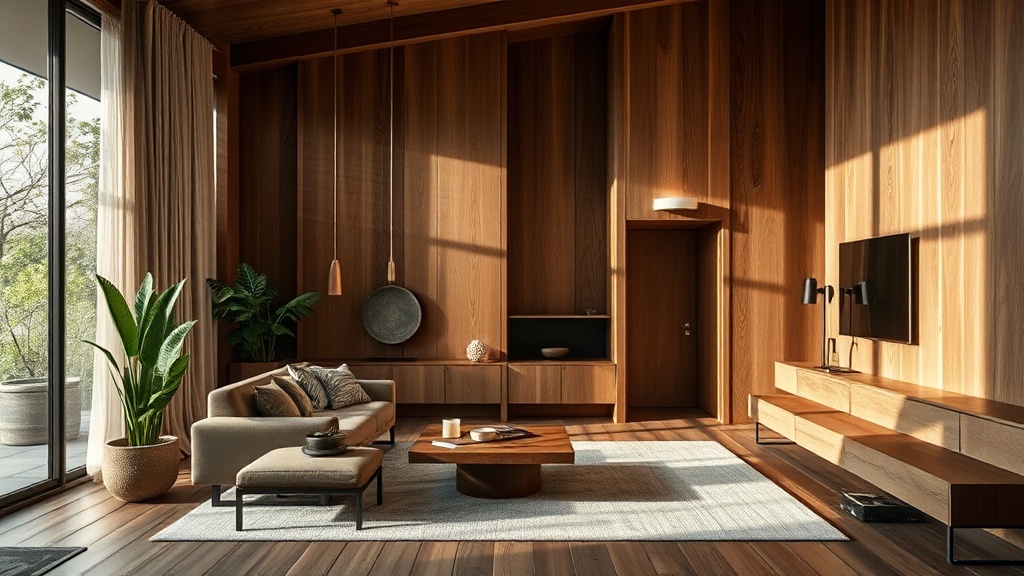
The Case for Natural Materials in Modern Interiors

This post examines why the shift toward organic textures—stone, wood, and linen—creates more enduring spaces than the pursuit of high-gloss synthetic finishes. You'll learn how to identify high-quality natural materials, why synthetic imitations often fail in a well-designed room, and how to integrate these elements without making a home look like a showroom-grade catalog.
Designers often talk about "mood," but they rarely talk about the physical weight of a room. A room filled with plastic, resin, and engineered laminates feels thin—it lacks the visual and tactile density that makes a home feel settled. When we choose a piece of solid walnut over a veneer, or a linen slipcover over a polyester blend, we aren't just choosing a look; we're choosing a material that ages with dignity. Synthetic materials are designed to look perfect until the moment they break; natural materials are designed to evolve.
Why does natural stone feel more luxurious than marble patterns?
The internet is flooded with high-resolution photos of "marble-look" quartz and porcelain tiles. While these are functional, they lack the soul of genuine stone. Real marble, travertine, or limestone possesses a unique grain that no machine can perfectly replicate. This variation—the slight imperfections and the way light hits a non-uniform surface—is what provides visual interest. A surface that is too predictable is, frankly, boring. It lacks the tension required to make a room feel alive.
If you are looking to incorporate stone, look toward the textures found in Architectural Digest for inspiration on how raw, unpolished surfaces can act as a centerpiece. A heavy, honed marble coffee table serves as an anchor for a room, providing a sense of permanence that a lightweight, composite piece simply cannot match. It is the difference between a temporary decoration and a permanent fixture.
How do I choose quality wood over cheap veneers?
The biggest mistake in modern interior design is the over-reliance on MDF (medium-density fiberboard) with a thin veneer. It might look fine in a showroom, but it lacks the structural integrity and the depth of grain found in solid timber. When selecting furniture, look at the edges. A well-made piece of furniture often shows the end-grain of the wood, which is a hallmark of quality.
Wood should feel warm to the touch and possess a certain weight. If a dining table feels hollow or sounds like a drum when you tap it, it's likely a hollow-core construction. Solid wood furniture can be refinished, sanded, and repaired. It can be a part of your life for decades. A veneer, once chipped or water-damaged, is essentially dead. Choosing solid wood isn't just a design choice; it's an investment in longevity. This is the essence of the "slow design" movement—the idea that we should own fewer, better things.
Can linen and wool replace synthetic textiles?
Texture is the silent language of a room. A room with only flat, smooth surfaces feels sterile and uninviting. This is where the interplay of textiles becomes vital. Linen, in particular, has a wonderful tendency to wrinkle—a trait that many people try to fight, but which actually adds a layer of relaxed, lived-in sophistication. A linen sofa or heavy linen drapery adds a soft, organic texture that synthetics like polyester simply cannot mimic.
Wool is another heavy hitter in the world of high-quality textiles. Whether it is a thick-pile rug or a heavy throw, wool provides a thermal and visual weight that anchors a seating area. When you pair a rough-hewn wooden table with a soft wool rug and linen cushions, you create a sensory experience. The contrast between the hard and the soft, the smooth and the textured, is what makes a room feel balanced rather than one-dimensional.
To understand the nuances of textile quality, observing the way light interacts with different weaves is helpful. A synthetic fabric often has a certain "plastic-y" sheen under bright light, whereas natural fibers absorb and diffuse light, creating a softer, more matte appearance. This is a small detail, but in a well-lit room, it makes a massive difference in how expensive and intentional the space feels.
Ultimately, the goal is to move away from the "disposable" mindset. When you shop for your home, ask yourself: "Will this look better in ten years?" A weathered brass lamp or a linen-clad armchair might look slightly more worn in a decade, but that wear is beautiful. It tells a story. It shows that the object is actually being used, rather than just sitting there as a static piece of decor. A home should be a collection of things that grow old with you, not a collection of things that you replace every three seasons.
"Design is not just about what looks good; it is about how a space makes you feel through the weight and texture of its components."
The next time you are browsing for a new piece for your home, ignore the trend reports. Instead, touch the material. Feel the grain of the wood. Notice the weight of the stone. These are the elements that will actually build a home worth inhabiting.