Terrazzo Is Not a Trend: The 500-Year-Old Floor That Outlasts Every Design Movement

Every few years, a design magazine rediscovers terrazzo. The headline is always some variation of "terrazzo is back." This implies it left. It did not leave. It was under your feet the entire time—in the lobby of your municipal library, in the corridor of the hospital where you were born, in the airport concourse you shuffled through at 5 a.m. without looking down once. Terrazzo did not go anywhere. You stopped paying attention.
That inattention is the point. Terrazzo is the rarest thing in design: a material so structurally honest that it becomes invisible. It does not perform. It endures. And the gap between those two verbs is the gap between most contemporary surface design and anything worth building a room around.
A Material Born from Refusal to Waste
The origin story matters because it explains everything that followed. In fifteenth-century Venice, marble workers had a problem: offcuts. Irregular chips and shards left over from cutting slabs for the palazzi of the rich. Rather than discard them, Venetian terrazzieri embedded these fragments into a wet lime binder, tamped the surface flat, and ground it smooth once cured. The result was a floor made entirely from remnants—geological time compressed into a construction leftover, then pressed into service again.
This is not recycling in the contemporary, feel-good sense. This is thrift as a structural principle. The material's logic is subtractive: you do not design terrazzo from a blank canvas. You design it from what is already there. The aggregate—marble, granite, quartz, glass, shell—dictates the palette. The binder holds and reveals. The grinding erases the boundary between fragment and field until you cannot tell where one chip ends and the matrix begins.
That erasure is terrazzo's greatest formal quality, and it is the one most designers ignore when they slap a "terrazzo pattern" onto a phone case.
The Divider Strip Changed Everything
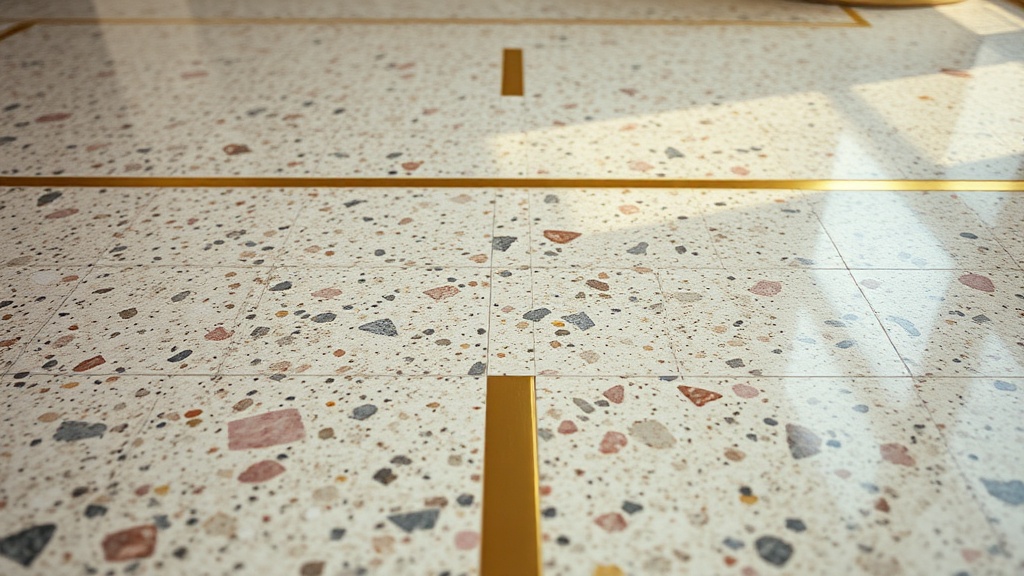
If you want to understand why terrazzo dominated American public buildings from the 1920s through the 1970s, look at the brass divider strip. This is the thin metal channel—usually zinc or brass—set into the wet matrix to control cracking and define pattern boundaries. It sounds like an engineering detail. It was an aesthetic revolution.
Art Deco terrazzo floors used divider strips the way a draughtsman uses ruling pens: to inscribe geometry directly into the ground plane. Curved lines, radiating sunbursts, interlocking chevrons—all made possible because the strip gave the terrazziere a way to separate colour fields without visible joints. The 1939 New York World's Fair pavilions were full of this work. So were Miami Beach hotels, Chicago department stores, and every second cinema lobby built between 1935 and 1955.
The mid-century shift was subtler. Divider strips became orthogonal grids rather than decorative flourishes. The floor stopped illustrating and started organising. Walk through the Gander International Airport lounge in Newfoundland—recently given heritage designation, and rightly so—and the geometric terrazzo underfoot is not decoration. It is a spatial score. The floor tells your feet where the room changes function before your eyes register the furniture arrangement.
That is what a good floor does. It works below the threshold of conscious attention. The moment a floor asks you to admire it, it has failed as architecture.
Why the Instagram Revival Misses the Point
Around 2017, terrazzo reappeared in café fit-outs, soap packaging, and wallpaper collections. The aesthetic was always the same: pastel aggregate chips on a white or blush ground, scaled up to look "playful." Memphis Group references were invoked. Ettore Sottsass was name-checked by people who had never held a copy of Terrazzo magazine (yes, there was one; Sottsass edited it in the late 1980s).
The problem with this revival is not that it was popular. Popularity is fine. The problem is that it extracted terrazzo's visual pattern while discarding its material logic. A digitally printed terrazzo wallpaper has no aggregate. It has no weight. It has no geological content. It is a photograph of a surface applied to another surface—a simulacrum with none of the qualities that make the original worth caring about.
Real terrazzo is heavy. It is cold underfoot in winter and cool in summer. It absorbs sound differently from tile or timber. It develops a patina over decades that no factory finish can replicate. When you re-grind a terrazzo floor that has been hidden under carpet since 1974, the aggregate appears as fresh as the day it was poured, because marble does not age the way paint does. The surface renews itself through subtraction. You grind away the worn binder and the stone reasserts itself.
This is a material that rewards maintenance over replacement. In an industry addicted to demolition cycles, that quality alone makes terrazzo subversive.
The Aggregate Is the Argument
I keep a sample board in the bookstore—six terrazzo tiles from different decades and geographies. A 1932 Venetian seminato with Carrara marble chips the size of lentils. A 1958 American palladiana with jagged Botticino fragments set in dark grey cement. A 1970s German hospital floor with quartz aggregate so fine it reads as solid colour from standing height. A contemporary Italian resin-bound tile with recycled mirror glass that catches light like a frozen puddle.
Each one tells you something specific about its origin. The Venetian tile says: we had Carrara offcuts and lime. The American tile says: we had industrial grinding machines and zinc strip. The German tile says: we had hygiene requirements and a modest budget. The contemporary tile says: we have waste glass and polymer chemistry.
No two terrazzo floors are identical because no two batches of aggregate are identical. This is the opposite of how most flooring works today. Porcelain tile is manufactured to be perfectly repeatable. Luxury vinyl plank is photographed from a single timber board and printed millions of times. These materials aspire to uniformity. Terrazzo aspires to controlled variation—the same logic, different particles, every time.
That controlled variation is what makes a terrazzo floor feel alive in a way that a printed surface never will. It is the material equivalent of letterpress versus laser printing: the same information, delivered with fundamentally different physical authority.
Pouring a Floor Is Still a Craft Act
The part of terrazzo that vanishes in every "terrazzo trend" article is the labour. In-situ terrazzo—the real thing, poured on site—requires a team of specialists working with wet cementitious or epoxy matrices, hand-scattering aggregate, setting divider strips to precise levels, then grinding the cured surface through progressively finer abrasive passes until it reaches the specified finish. The process takes days. It cannot be rushed. Temperature, humidity, and aggregate distribution all affect the final result.
Pre-cast terrazzo tiles simplify the logistics but retain the material truth: real stone, real binder, real grinding. The craft has not been automated away. It has been refined. And in a construction industry that increasingly treats every surface as a commodity to be installed by the lowest bidder in the shortest time, that insistence on craft time is worth defending.
I do not say this out of nostalgia. Nostalgia is the enemy of good design. I say it because a floor poured by hand from local aggregate connects a building to its geology in a way that a container of imported porcelain tile from Guangdong does not. The material carries place. It carries time. It carries the specific gravity of the stone that was quarried within driving distance of the site.
If that sounds romantic, walk into any 1950s civic building with its original terrazzo intact. Stand there for thirty seconds. Then walk into the nearest co-working space with its luxury vinyl plank. Your feet will explain the difference faster than I can.
The Floor Remembers
Terrazzo is the only common flooring material that improves with re-grinding rather than requiring replacement. A well-maintained terrazzo floor can last the lifetime of the building. Not "up to 75 years with proper care," as the marketing copy says—the actual lifetime of the building. There are terrazzo floors in Venetian churches that predate the printing press.
This durability is not incidental. It is the material's core proposition: that a floor should outlast the people who specified it, the trends that surrounded it, and the budgets that paid for it. In a discipline obsessed with the new, terrazzo's quiet persistence is the most radical design statement available.
It was never a trend. Stop calling it one.