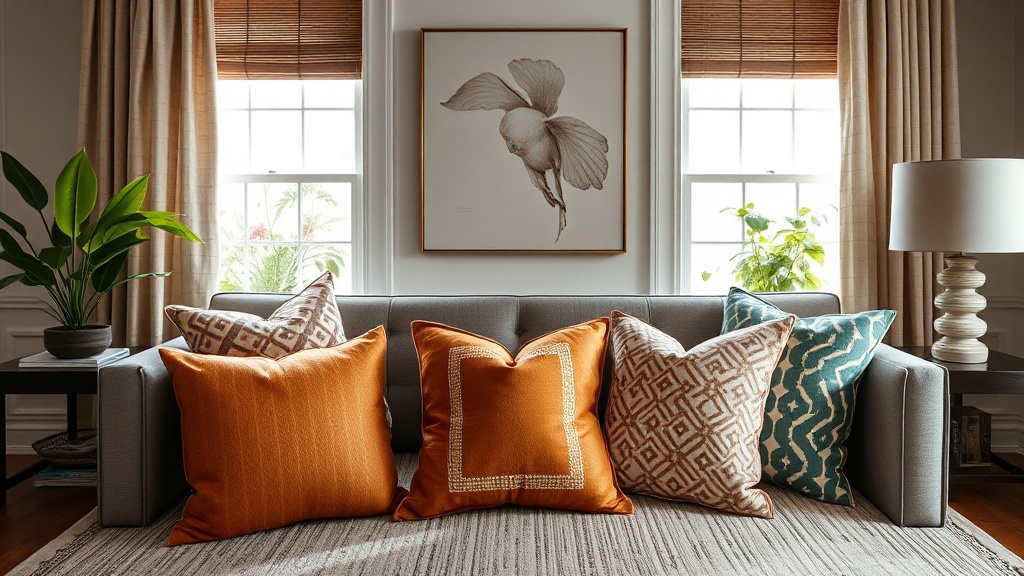
How to Arrange Throw Pillows Like a Professional Designer

What This Guide Covers (And Why Throw Pillows Deserve Your Attention)
Throw pillows sit at the intersection of comfort and curation—the most democratic design element in any room. This guide breaks down the exact formulas professional designers use to arrange accent pillows on sofas, beds, and chairs. You'll learn the 2-2-1 rule, how to layer textures without creating visual chaos, and why the wrong pillow can undo an otherwise perfect living room. Master these principles and any space transforms from catalog-generic to intentionally composed.
What's the Rule for Arranging Throw Pillows on a Sofa?
The 2-2-1 method remains the industry standard: two large anchors (22-24 inches), two medium accents (18-20 inches), and one lumbar or odd-shaped piece. This asymmetrical formula creates visual tension while maintaining balance.
Start with the largest pillows at each outer corner of the sofa. These anchor pieces ground the arrangement and establish the color story. The two medium pillows sit slightly in front, angled toward the center. The final piece—perhaps a Moroccan wedding blanket lumbar or a vintage silk kantha—lives dead center or slightly off-center.
The catch? Scale matters more than most people realize. A 24-inch pillow on a 72-inch sofa looks proportional. That same pillow on an 84-inch sectional disappears. Designers measure twice and buy once. Here's the thing about symmetry: it reads as formal, almost hotel-lobby stiff. The 2-2-1 arrangement breaks that rigidity without sacrificing intentionality.
For a standard three-seat sofa (roughly 84 inches), try this configuration:
| Position | Size | Purpose | Texture/Pattern |
|---|---|---|---|
| Far left corner | 24" x 24" | Anchor | Solid linen or velvet |
| Left-center | 20" x 20" | Transition | Subtle stripe or small-scale geometric |
| Center | 14" x 20" lumbar | Focal point | Bold pattern or contrast texture |
| Right-center | 20" x 20" | Transition | Complementary solid or tonal pattern |
| Far right corner | 24" x 24" | Anchor | Solid linen or velvet |
Worth noting: the 2-2-1 rule adapts. A loveseat might run 1-1-1. A massive sectional could handle 3-2-1 or even asymmetric clusters of 2-2 on one end and a single statement piece on the other.
How Do You Mix Throw Pillow Patterns Without Clashing?
Combine three distinct pattern scales—large, medium, and small—within a unified color palette. The large-scale pattern (botanical print, bold stripe) commands attention. The medium pattern (geometric, ikat) provides rhythm. The small pattern (texture, micro-print) adds depth without competition.
Designers follow the 60-30-10 distribution. Sixty percent of your pillows should share a dominant color (perhaps the sofa's tone or a wall color). Thirty percent introduces a secondary hue. Ten percent delivers the accent—that pop of ochre, rust, or cobalt that makes the arrangement sing.
That said, pattern mixing terrifies most people. The safe route? Pair organic patterns (florals, botanicals) with geometric ones (stripes, checks, dots). Never combine two competing organic patterns of similar scale—they fight for attention. A House Beautiful guide on pattern mixing suggests limiting yourself to one "hero" pattern per arrangement.
Real-world application: Start with a solid base. The Faye linen pillow covers from Pottery Barn in warm white or natural oatmeal provide the perfect canvas. Layer in one Schumacher Chiang Mai Dragon (large scale, traditional). Add a ticking stripe in complementary navy. Finish with a nubby bouclé or vintage kilim lumbar. Each piece speaks a different visual language, but they share a common accent color.
Texture functions as pattern's quieter cousin. A velvet against linen against leather creates visual interest without risking pattern overload. The eye reads these textural shifts as complexity—even when every pillow is technically a solid.
How Many Throw Pillows Should Go on a Bed?
The Euro-sham method calls for three 26-inch squares against the headboard, followed by two standard sleeping pillows, then one or two accent pillows, and finally a lumbar or bolster at the front. That's the hotel look—polished, intentional, slightly formal.
But beds aren't sofas. You actually sleep there. The practical approach: two Euros (or none), your sleeping pillows in proper shams, and one statement accent. Anything beyond that becomes staging, not living.
King beds accommodate three Euros across the back. Queens handle two. Twin beds look best with a single Euro or a vertical arrangement of one standard plus one accent. The key is maintaining negative space. A bed crowded with pillows signals a showroom, not a sanctuary.
The throw blanket layer complicates pillow placement. If you're draping a Morgan & Finch cashmere throw across the foot of the bed, reduce your pillow count by one. Visual weight accumulates. Two mediums and a lumbar read as balanced when a textured throw anchors the lower third.
What Sizes of Throw Pillows Work Best Together?
Professional arrangements rely on 4-inch increments. Pair 24-inch anchors with 20-inch accents. Layer 22-inch bases with 18-inch mid-layers and 14-inch lumbars. This graduated sizing creates depth and prevents the "wall of square" effect that amateur setups suffer from.
Here's the thing about inserts: always size up. An 18-inch cover demands a 20-inch feather-down insert. The overstuff creates that coveted karate-chop structure—that sharp vertical crease designers love. Synthetic fills don't compress the same way. They look puffy, not plush.
Lumbar pillows (typically 12" x 20" or 14" x 24") serve as the period at the end of a pillow sentence. They break up square monotony. They support lower backs. They introduce horizontal lines that contrast with vertical furniture silhouettes.
Bolsters and rounds work as wildcards. A cylindrical velvet bolster on a leather sofa adds sculptural interest. A round Moroccan pouf-style pillow on a linen bed introduces geometry. These irregular shapes work best as the "one" in a 2-2-1 or as solo statements on accent chairs.
Where Should You Place Throw Pillows on Chairs and Sectionals?
Accent chairs demand restraint. One 20-22 inch square suffices. Perhaps add a lumbar if the chair depth supports it. The pillow should relate to—but not match—the sofa arrangement. Pull one color from the main palette. Introduce one new texture.
Sectionals require zone thinking. Treat each linear segment as its own arrangement. The long side might run 2-2-1. The chaise gets one anchor and one accent. Never carry the same pillow configuration across an entire L-shaped or U-shaped sectional—it reads as repetitive, not cohesive.
Corner sectionals present a specific challenge: the joint where two segments meet. This dead zone either gets nothing (clean, modern) or becomes a pillow cluster opportunity. If clustering, use odd numbers—three pillows of varying sizes stacked artfully. Think of it as a still life composition.
Outdoor furniture follows the same principles with material constraints. Sunbrella fabrics. Mold-resistant fills. But the 2-2-1 rule still applies to that Serena & Lily Capistrano outdoor sofa. The arrangement reads as intentional whether indoors or out.
What Are the Most Common Throw Pillow Mistakes?
Buying matching sets of four from big-box retailers tops the list. Those pre-coordinated pillow packs—two geometrics, two solids, all the same size—signal "I gave up." Professional arrangements evolve. They're collected over time. The McGee & Co. aesthetic works because it looks assembled, not purchased.
Karate-chopping every pillow is another amateur tell. Some pillows should look relaxed. The lumbar might hold a crisp fold. The back anchor pillow stays untouched. Selective structure reads as sophisticated; uniform chopping reads as trying too hard.
Ignoring the 18-inch minimum for sofas cripples most arrangements. Those 16-inch "accent" pillows from Target disappear against standard 36-inch sofa backs. They look like afterthoughts. Scale up or stay home.
The final sin? Buying pillow covers and inserts together from the same retailer. Inserts should always come from specialty sources—Down and Feather Company, PillowFlex—in sizes 2 inches larger than the covers. The mass-market poly-fill pillows included with covers create sad, saggy shapes within months.
Great pillow arrangement rewards attention. It doesn't demand constant adjustment. When the proportions are correct, when the textures converse, when the colors respect the room's larger story—the pillows simply sit there, doing their job. That's the mark of professional design. Invisible intentionality.
Steps
- 1
Start with a Solid Foundation of Neutral Base Pillows
- 2
Layer in Pattern and Texture for Visual Interest
- 3
Add a Statement Pillow to Complete the Look