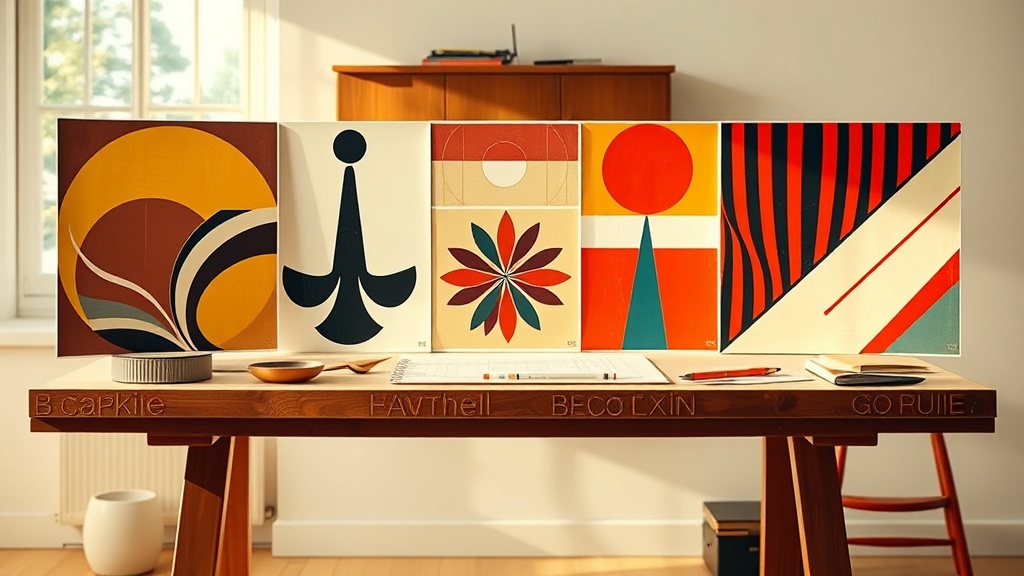
Design Movements Shaping Modern Interiors: A Quick Roundup

Ever walked into a room and felt a century‑old conversation humming in the walls? From the sinuous curves of Art Nouveau to the neon optimism of Googie, five design movements continue to shape the spaces we inhabit—whether you notice them or not.
In this quick‑hit roundup I’ll map each movement’s core DNA, flag where it resurfaces in 2026 interiors, and give you a concrete way to weave a touch of history into your next project.
What Are the Core Characteristics of Art Nouveau?
Art Nouveau (c. 1890‑1910) champions organic, flowing lines inspired by plants and the human form. Its hallmark is the whiplash curve—think wrought‑iron balconies that curl like vines. Julian’s Berlin studio still houses a walled garden where I pair reclaimed mahogany with hand‑blown glass to echo that tactile sensuality.
How Does Bauhaus Still Influence Minimalist Interiors?
Born in Germany in 1919, Bauhaus reduces design to function and geometry. Rectilinear forms, primary colors, and an unadorned material palette make it the great‑grandfather of today’s terrazzo revivals. I often layer a Bauhaus‑inspired grid behind a custom textile to keep the space disciplined yet alive.
Why Is De Stijl Relevant to Modern Color Schemes?
De Stijl (1917‑1931) strips visuals to horizontal and vertical lines, using only black, white, and primary colors. The movement’s stark logic feels at home in open‑plan lofts where I tame the storm of space with a color‑blocked shelving unit. Its legacy lives on in today’s “color blocking” trends.
What Makes Memphis Design a Bold Statement Today?
Memphis (early 1980s) embraces kitsch, asymmetry, and clashing hues. It’s the rebellion against “clean” minimalism—exactly the kind of “ugly‑useful” honesty I champion. A single Memphis‑style accent chair can turn a restrained kitchen—like the century‑old kitchen I documented—into a conversation starter.
How Does Googie Capture Futuristic Optimism?
Googie (mid‑1950s‑60s) is the space‑age cousin of Mid‑Century Modern, with sweeping angles, neon signage, and a love of motion. Its influence pops up in today’s “maximalist” lounges where I layer a Googie‑inspired lighting fixture over a Bauhaus floor grid, creating a dialogue between past optimism and present restraint.
What’s the Practical Takeaway for Your Space?
Pick one “DNA strand” from each movement and let it inform a single design decision:
- Art Nouveau: introduce a hand‑crafted metal railing or botanical motif.
- Bauhaus: choose a functional furniture piece with clean geometry.
- De Stijl: apply a primary‑color accent wall or shelving.
- Memphis: add a bold patterned rug or chair.
- Googie: install a futuristic pendant light or angled shelving.
By anchoring your interior in these historic codes, you create depth that outlasts fleeting trends—exactly the rebellion against “spectacle” we need.
Where Can I Learn More?
These movements are documented in depth by institutions that guard design heritage:
- MoMA’s Bauhaus collection
- V&A’s Art Nouveau overview
- Design Museum on Memphis
- Smithsonian’s Googie archive
- The Art Newspaper on De Stijl centennial
Dig into these resources, then experiment in your own studio. The past is a toolbox—use it boldly.