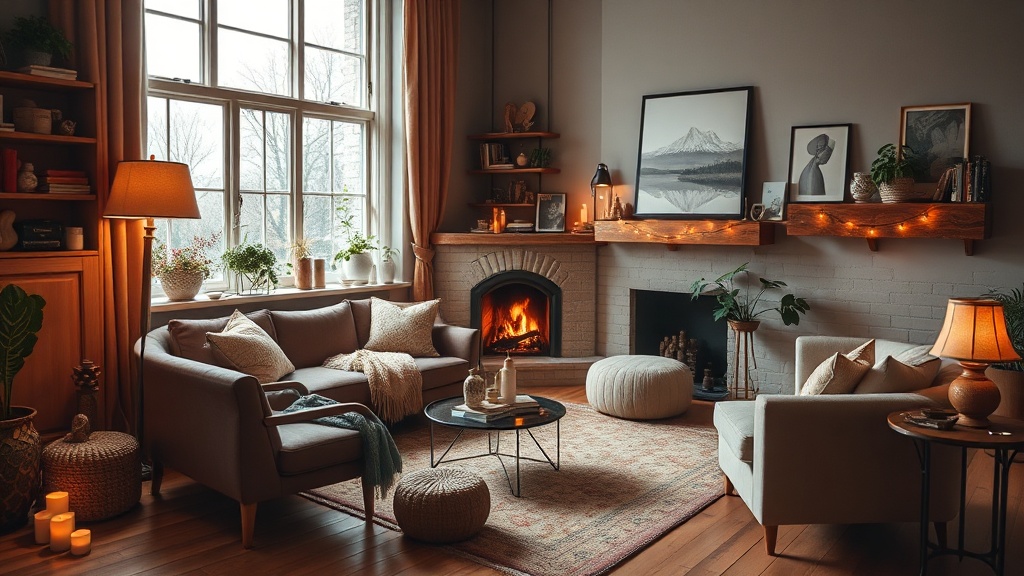
Cozy Living Room Ideas: Transform Your Space with Warmth and Style

Creating a living room that wraps around you like a favourite jumper isn't about following fleeting trends. It's about understanding how light, texture, and proportion work together to make a space feel intentional yet effortless. This post explores practical approaches to warmth—from layering textiles to selecting the right colour palette—so you can craft a room that feels collected over time rather than staged for a catalogue.
How do you make a living room feel cozy without clutter?
The answer lies in curated warmth: fewer, better pieces arranged with purpose. A cluttered room suffocates; a sparse one feels cold. The middle ground? Three to five anchor elements that command attention, surrounded by breathing room.
Start with scale. An oversized sofa in a compact space doesn't read cozy—it reads cramped. That said, a too-small piece in a large room feels like furniture in a waiting area. The Design Within Reach Neo Lounge Chair demonstrates this balance beautifully: substantial enough to anchor a corner, yet open enough underneath to maintain visual flow.
Negative space isn't empty space. It's the pause between notes that makes the music work. Leave 18 inches minimum between seating pieces. Resist the urge to fill every wall. One large artwork often creates more impact (and more calm) than a gallery cluster.
Storage solves the clutter problem before it starts. The IKEA SÖDERHAMN series offers deep seats with removable covers—practical for families—while built-in shelving from California Closets keeps collections contained. The goal isn't minimalism for its own sake. It's intentionality.
"A room should feel like it's been furnished over generations, even when everything arrived last Tuesday."
What colours make a living room feel warm and inviting?
Warm undertones transform a space more dramatically than any throw pillow ever could. Think ochre over stark white, sage over clinical green, terracotta over fire-engine red.
The Farrow & Ball "Studio Green" demonstrates this principle—it's deep, yes, but the underlying yellow keeps it from feeling oppressive. Pair it with "Pointing" on trim for contrast that reads gentle rather than jarring. For something lighter, Little Greene's "Jewel Beetle" shifts with the light throughout the day, from warm grey to soft green.
Neutrals need backbone too. Beige isn't beige anymore—it's "London Clay" (also Farrow & Ball), it's "Shadow White," it's "Drop Cloth." These colours contain complexity. They shift. They respond to lamp light differently than daylight.
Here's the thing about accent walls: they often read as indecision. Better to commit fully or not at all. A whole room in Little Greene "Basil" feels enveloping. One wall in that same colour feels apologetic.
| Colour Family | Specific Shade | Best For | Pair With |
|---|---|---|---|
| Deep Green | Farrow & Ball Green Smoke | North-facing rooms | Brass, walnut, cream linen |
| Warm Clay | Little Greene Orange Aurora | Creating intimacy | Black accents, natural oak |
| Complex Grey | Farrow & Ball Pavilion Gray | Modern traditional | Leather, chrome, indigo |
| Soft Blue | Little Greene Dock Blue | Calming presence | Unbleached wood, terracotta pots |
Worth noting: paint looks different on every wall. Buy tester pots. Live with them for three days minimum. That colour you loved in the shop might feel completely different under your pendant lights at 8 PM.
How do you layer lighting for a cozy atmosphere?
Single-source lighting kills warmth faster than anything else. The goal is three layers: ambient, task, and accent—each dimmable, each contributing differently.
Ambient light should barely register consciously. Recessed downlights, if you must have them, need to be warm (2700K maximum) and positioned carefully to avoid that airport-lounge uniformity. Better still: a central pendant with character. The Heath Ceramics pendant shade casts a glow that's distinctly handmade—slight variations in the glaze mean no two lights behave identically.
Task lighting addresses specific needs. Reading corners demand something adjustable. The Anglepoise Type 75, designed by Sir Kenneth Grange, offers industrial heritage with genuine functionality. Position it 15 inches above shoulder height when seated. Too high and it glares; too low and it isolates.
Accent lighting creates depth. Picture lights above artwork (try the Hogarth Lighting LED range). Uplighters behind large plants. LED strips tucked behind shelving. These aren't decorative extras—they're what separate a designed room from a furnished one.
The catch? Colour temperature consistency matters. Mixing 3000K and 2200K in the same sightline creates visual discomfort. Choose a family and stick with it. Most people gravitate toward 2700K for living spaces—warm without being yellow, clear without being clinical.
Texture: the forgotten element
While everyone obsesses over colour, texture does the heavy lifting for comfort. Smooth surfaces feel cold. Varied textures invite touch—and invitation is what coziness means.
Start with the largest surface: the floor. A vintage Beni Ourain rug (source from 1stDibs or The Rug Company for new interpretations) provides the foundation. These Moroccan pieces aren't just beautiful—their high pile and natural variations hide everything from red wine to Labrador hair.
Layer textiles deliberately. Linen curtains (Liberty's Tana Lawn cotton works for lighter rooms) soften window edges. A wool throw on the sofa arm—consider the heritage blankets from Tweedmill Textiles in Wales. Velvet cushions in varying depths (Abbott & Boyd does excellent Belgian linen velvet).
Natural materials age better than synthetic ones. A leather Chesterfield develops patina. A linen sofa softens. Solid oak dulls to a glow. These aren't imperfections—they're evidence of life being lived.
Arranging furniture for conversation (and comfort)
The best living rooms facilitate connection. That means positioning seating for eye contact, not television viewing. The classic arrangement: sofa facing two chairs, separated by a coffee table approximately 18 inches high—low enough for resting feet, high enough for coffee cups.
Traffic flow matters. People shouldn't cut through conversation zones to reach other rooms. A clear perimeter path keeps the centre intimate. That said, pushing all furniture against walls creates a dance-hall effect that feels institutional, not residential.
Consider the "floating" arrangement. A sofa placed perpendicular to a fireplace, with a console behind it, defines zones without walls. The console becomes a place for lamps, books, objects collected over time. The West Elm Pure Console offers this functionality at a mid-range price point.
What small changes make the biggest impact?
You don't need a renovation to transform a space. Sometimes the smallest edits shift the entire feeling.
Swap out lamp shades. A parchment shade diffuses light softly; a black paper one directs it precisely. Both cost under £50 and change a room's evening character completely.
Add something living. Not a fiddle-leaf fig (overplayed, finicky)—try a mature olive tree from Patch Plants or a simple vase of dried grasses. Living things introduce unpredictability, and unpredictability reads as warmth.
Rearrange your books. Colour-coordinated spines please Instagram; varied heights and orientations please the eye. Stack some horizontally. Lean others. Leave gaps. This isn't mess—it's visual rhythm.
Finally, consider scent. The P.F. Candle Co. "Teakwood & Tobacco" or Cire Trudon's "Abd El Kader" don't just smell good; they create memory associations. Your living room becomes a place not just seen but experienced through multiple senses.
A cozy living room isn't a destination. It's an evolution—a space that responds to seasons, to moods, to the slow accumulation of a life well-lived. Start with these principles. Then let the room teach you what it wants to become.