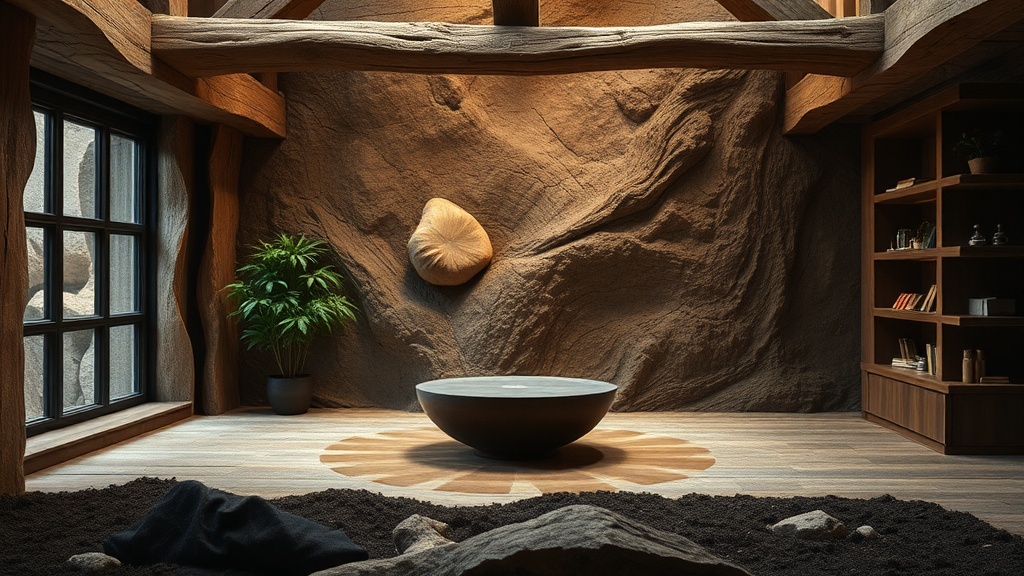
Beyond the Ephemeral: Understanding the Enduring Value of Natural Materials

How do we craft spaces that feel authentic, lived-in, and resist the relentless churn of trends?
In a world saturated with fleeting aesthetics and disposability, the question of enduring design integrity becomes more pertinent than ever. This piece explores the profound impact of natural materials in interior design, delving into why wood, stone, linen, and wool don't just furnish a room, but enrich it with character, tactility, and a quiet sense of permanence. We're talking about more than just a surface aesthetic; we're considering the intrinsic qualities that allow these elements to age gracefully, telling a story that mass-produced alternatives simply can't.
For centuries, human dwellings were shaped by the earth’s direct offerings—timber from the forest, stone from the quarry, fibers from plant and animal. There was an inherent honesty to these materials, a direct connection between their origin and their purpose. Today, with an almost infinite array of synthetic options, we sometimes forget the grounding power of the genuine article. Yet, the finest interiors, those that truly resonate and stand the test of time, almost invariably feature a considered integration of natural elements. They offer a counterbalance to our increasingly digital lives, providing a tangible warmth and a connection to something deeper than mere utility.
What makes natural materials so inherently timeless?
It's not just about tradition; it's about inherent qualities. Take wood, for instance. Its grain patterns are a record of growth, its imperfections a testament to its organic journey. A well-crafted oak table doesn't just serve a function; it possesses a narrative. As it ages, it develops a patina—a softening of its surface, a deepening of its color, minor dents that mark shared meals and quiet moments. This isn't wear and tear to be hidden away, but rather a badge of honor, a visual history accruing value over time. Synthetics, by contrast, tend to degrade, to become brittle, to look tired, rather than ripened. They lack that vital capacity for evolution.
Stone—marble, granite, slate—offers another masterclass in longevity. Its coolness, its density, its unique veining speak of geological eons. A stone countertop isn't just practical; it’s an anchor, a piece of ancient earth brought indoors. The way light plays across its surface, the subtle shifts in its color depending on the time of day, all contribute to a dynamic beauty that never feels stagnant. Unlike a printed laminate, which aims for an illusion of depth, natural stone possesses true, irreducible depth. It demands respect, and in return, it imbues a space with a sense of solidity and gravitas. Its very presence suggests a home built to last, not merely a temporary abode.
Then there are the fibers: linen, wool, cotton, silk. These aren't just textiles; they are breathers, insulators, and gentle companions to daily life. Linen, with its beautiful crinkle and strength, only improves with each wash, becoming softer and more supple. Wool, resilient and naturally flame-retardant, offers unparalleled warmth and texture, whether in a hand-knotted rug or a chunky throw. These materials engage our tactile senses in a way that polyester or acrylic simply cannot. They invite touch, creating a more sensuous and comforting environment. Their textures add layers of visual interest and physical comfort, quietly enriching the sensory experience of a room. For more on the inherent durability of these fibers, consider exploring resources on natural textile properties, such as those found on