9 Open-Shelving Moves That Make a Kitchen Look Collected, Not Cluttered

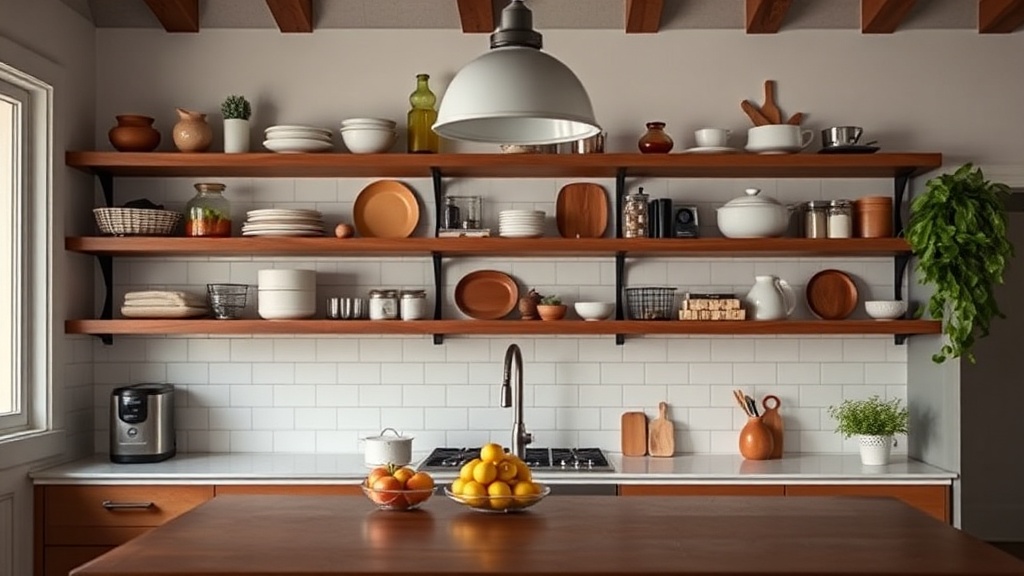
This is how to make open kitchen shelves feel calm, useful, and quietly beautiful. The point isn't to stage a showroom. It's to arrange the dishes, glassware, books, jars, and odd practical objects you already own so the room reads as deliberate instead of noisy.
Open shelving goes wrong when every object asks for attention at once. A shelf packed to the edge can be expensive, tasteful, and still look cheap because the eye has nowhere to rest. Good styling works by rhythm: repetition, contrast, breathing room, and a little restraint at the exact moment you want to add one more thing.
Why do open shelves look messy so fast?
Because they collect visual weight faster than cabinets do. A closed door edits for you; an open shelf tells the truth. Labels turn outward, mug handles flare in different directions, and every packet of tea becomes part of the room's composition. That's why museum storage and display teams spend so much time on spacing and grouping. If you want a useful reference point, Cooper Hewitt's note on glass collection storage is a reminder that visibility and order are never accidental.
How many things should sit on each shelf?
Usually fewer than you think. On a standard kitchen shelf, two or three grouped moments are easier to read than a continuous parade of objects. Think in clusters, not rows. A stack of plates, a short run of glasses, and one looser element such as a bowl or small framed print will almost always look better than seven unrelated pieces lined up like suspects.
| Shelf zone | Best use | What to avoid |
|---|---|---|
| Eye level | Everyday plates, bowls, glasses | Tiny trinkets that disappear |
| Above eye level | Serving pieces, baskets, large bowls | Heavy items used every morning |
| Lowest open shelf | Cookbooks, crockery, sturdy jars | Fussy decor that reads as clutter |
What colors keep a shelf wall from feeling busy?
A narrow palette does most of the work. That doesn't mean everything must match. It means your pieces should speak the same language. White ceramic, smoked glass, pale wood, brushed steel, and one darker note can carry a great deal of variety without turning shrill. If you need to train your eye, look at historical furniture and interiors in the V&A furniture collection. The lesson isn't to imitate period rooms; it's to notice how materials hold a conversation across contrast.
Where should the heaviest pieces go?
Lower than your prettiest ones. Weight should settle the composition, not threaten it. Large mixing bowls, crockery stacks, and dense cookbooks belong where they give the shelf line some ballast. Lighter glassware and smaller objects can rise above them. When every shelf carries the same visual density, the whole wall starts to hum in an unpleasant way.
9 Moves That Change the Whole Picture
Start with the dishes you use before you add anything decorative
The strongest open shelves are built from honest objects. Put your daily plates, bowls, mugs, and drinking glasses in place first, because they establish the real rhythm of the kitchen. Decorative pieces should support that rhythm, not interrupt it (yes, even the pretty striped bowl). If an arrangement makes daily movement awkward, it will collapse within a week. Style the shelf around habits that already exist; that's what gives it that unforced, settled character.
Keep one item type repeating across the full run
Repetition calms the eye. Maybe that's white dinner plates on two shelves, amber glass in pairs, or a run of linen-bound cookbooks with similar heights. Repetition doesn't make a room boring; it gives variation a frame. Without it, every object competes alone. With it, even one eccentric piece can land beautifully. If you've inherited mismatched crockery, choose one common thread to pull forward: all matte finishes, all pale tones, or all rounded silhouettes. The room doesn't need symmetry. It needs an accent you can hear from across the space.
Let negative space do some of the styling
Empty space is not wasted space. It's what turns a shelf from storage into composition. Leave a clear stretch beside a stack of bowls or above a lower cluster so the forms can register. People often fear blankness, then overfill the gap with another jar, another vase, another board. That's the exact moment the arrangement loses grace. A shelf should offer pause as well as content. Think of a well-kerned line of type: the letters matter, but the intervals are what make them readable.
Mix heights, but keep the height changes deliberate
If every object is roughly the same size, a shelf goes flat. If the height shifts are random, it looks jumpy. Aim for a few controlled rises and falls instead. A low stack of plates beside a taller carafe, followed by a medium bowl, creates a line the eye can follow. Boards leaned at the back can add height without needing extra depth. This is one of those small moves that makes a shelf feel composed rather than improvised—especially in kitchens where upper cabinetry has been removed and the shelf wall carries more visual responsibility.
Use texture to warm up plain ceramics
Many open shelves fail not because they are busy, but because they are sterile. If everything is hard, glossy, and bright white, the arrangement can feel more like retail display than domestic life. Add texture with a woven tray, unfinished wood utensils, stoneware, or a soft-bound cookbook with a worn spine. Those quieter surfaces catch light differently and stop the shelf from becoming one long reflective stripe. The goal is tactility, not rustic theatre. A little grain and matte finish go a long way.
Hide the ugly packaging before you style around it
Tea bags in bright cartons, pasta in half-open plastic sleeves, vitamin bottles, coffee pods, and loose foil packets will sabotage even the most careful shelf arrangement. Decant what deserves decanting and demote the rest to closed storage. Clear jars can work, but only when their contents are orderly and the jar shapes relate to one another. If you are planning a more serious kitchen update, the National Kitchen & Bath Association is worth consulting for broader planning standards; better shelf styling starts with better storage decisions behind the scenes.
Give one shelf a quieter job than the others
Not every shelf has to perform at the same volume. Let one shelf hold almost nothing beyond a stack of plates and a single bowl, or a short line of glasses and one small artwork. That quieter shelf acts like a landing strip for the eye. Without it, the wall can feel as if it is speaking too quickly. This matters most in small kitchens, where open shelving is often used to make the room feel larger. Space doesn't read as spacious because there is more to look at. It reads as spacious because there is less visual friction.
Bring in one non-kitchen object with a reason
A framed postcard, a brass candlestick, a small drawing, or a narrow vase with one branch can save open shelving from feeling purely functional. The trick is to choose something that changes the mood without pretending the kitchen is a gallery. One object is often enough. Two can work. Five is usually too many. The best non-kitchen additions have some relation to scale, material, or memory. They make the room feel inhabited, not styled for inspection. A shelf should reveal taste, yes, but also temperament.
Finish by editing from left to right, not by adding one more accent
Once everything is in place, step back and remove at least three things. Then look from left to right as though you were reading a line of print. Where does your eye snag? Where does it speed up? Where does one shelf feel heavier than the next? Edit there. Most shelf problems are editing problems, not shopping problems. You don't need another ceramic pitcher. You may need to move the tall one you own, split the stack of bowls in two, and let a plain section remain plain. That's where the room begins to look collected instead of merely occupied.
Open shelving looks refined when ordinary objects seem at ease with one another.
Before you buy new containers or chase another styling trend, empty one shelf completely and rebuild it with fewer moves than feels comfortable. Put back the pieces that earn their keep, place the heavier notes low, repeat one material, and leave enough room for the air around things to do its part. The room will tell you, quite quickly, when you've stopped decorating and started composing.