The Spaceship on Wilhelmplatz: How a Brutalist Embassy Outlasted Its Regime
By Design Inspiration ·
A meditation on the Czech Embassy in Berlin—locally known as Raumschiff Enterprise—a brutalist vessel designed by suppressed architects that transforms from grey concrete to molten gold as the day progresses.
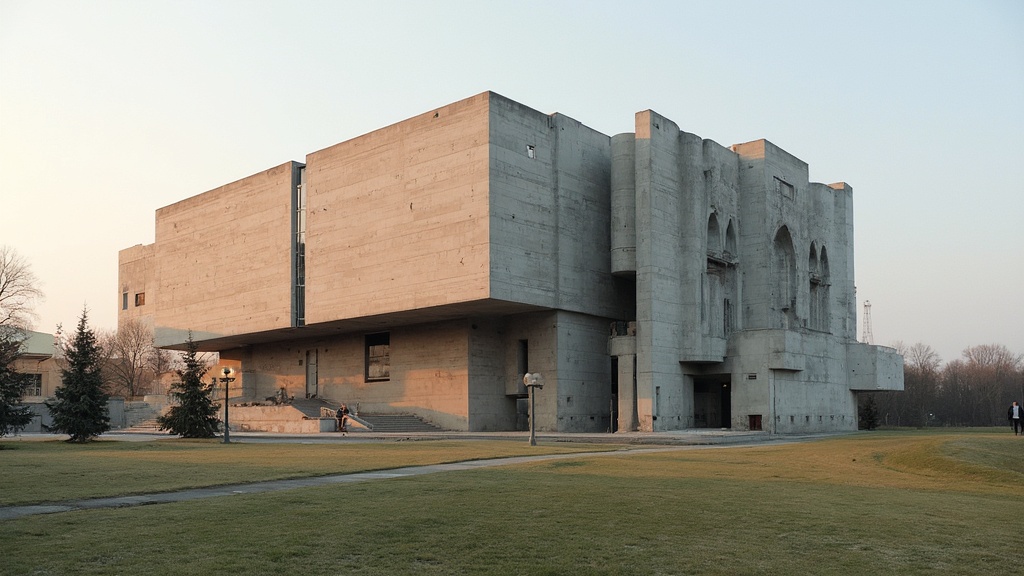
Fifteen minutes on foot from my bookstore, at the corner of Wilhelmstraße and Mohrenstraße, a concrete vessel appears to have descended from another era. Locals call it Raumschiff Enterprise—the Starship Enterprise. To dismiss this as mere nickname is to miss the point. The Czech Embassy in Berlin does not resemble a spacecraft; it behaves like one. It is a machine for diplomacy, constructed during the Cold War's twilight, designed by architects whose authorship was suppressed until their regime collapsed.
Note the way the structure refuses to meet the street. Instead of a welcoming plinth, you encounter a concrete podium—an elevated platform that suspends the building's mass above the ground plane. This is not architectural arrogance. It is a response to the site: Wilhelmplatz, 1972, a terrain vague in the shadow of the Wall. The Machonins—Věra Machoninová and Vladimír Machonin—designed a building that literally rises above its divided circumstances.
The composition reads as three horizontal strata. Below, a glass-enclosed ground floor (transparent, theoretically accessible—though embassy security has complicated this reading). Above, the main volume: a brutalist container of offices and ceremonial spaces, wrapped in a concrete grille that performs multiple duties. It screens. It ventilates. It creates that rhythmic shadow pattern that makes the facade appear to vibrate when the sun strikes at oblique angles. And crowning the assembly, a cantilevered conference volume that projects eastward like a prow.
But the material is where this building truly earns its permanence. The concrete is not the lazy, gray porridge of so much mid-century construction. It is bush-hammered, textured, almost petrified. And here is what the photographs rarely capture: the chromatic transformation. What reads as austere mineral grey at noon becomes molten amber in the hour before sunset. The aggregate—quartz, limestone, the geological particularities of Bohemian geology—catches the low western light and ignites. I have stood on the opposite corner at 6 PM in February and watched the embassy appear to smolder. It is the only building I know that changes its emotional register based on the time of day.
The Machonins were not supposed to be the authors. The official credits listed Klaus Pätzmann, a party-approved figurehead. The true designers—a husband-and-wife team operating in the restrictive atmosphere of normalized Czechoslovakia—remained anonymous until 1990. Their building, conceived in 1972 and completed in 1978, outlasted the political system that tried to erase their names. This is not incidental biography. It is the essential context. Raumschiff Enterprise is a testament to intentionality surviving ideology.
The embassy has faced existential threats. Its energy demands—heating, cooling, maintaining that glass curtain wall in a Berlin winter—became unsustainable as diplomatic staff dwindled. Demolition was discussed. Preservationists intervened. In 2022, the building was listed as a protected monument. It will remain.
There is a lesson here for anyone who believes design must be "of its moment" to matter. The Machonins did not design for 1978. They designed for permanence. The cantilevered conference room that once hosted Warsaw Pact negotiations now accommodates EU delegation meetings. The concrete has developed its patina. The glass has been replaced twice. But the gesture—the horizontal thrust, the lifted podium, the rhythmic grille—remains uncompromised.
I return to this building when the work in my bookstore feels too small. When the digital ephemera of contemporary design culture overwhelms. Standing before that grille, watching the shadow pattern shift across the bush-hammered surface, I am reminded that architecture is the slowest, most honest form of design. It cannot be updated with a software patch. It cannot be A/B tested. It simply endures—or it fails—and we judge it across decades, not quarters.
The takeaway: Intentionality that outlasts its circumstances is the only measure of design that matters. Everything else is marketing.